
Why AI Speed and Reliability Matter to Your Business
If you run a Malaysian SME, you probably do not care how many parameters an AI model has. You care whether it can answer customer questions accurately, summarise a long tender document, update your CRM, read an invoice, or help your team complete routine work without slowing everyone down.
That is why the latest developments in open AI models deserve your attention. Two Chinese AI labs independently released models with remarkably similar internal designs: Z.ai’s GLM-5.3-Flash and Alibaba’s Qwen3.8-Flash-Next. Their technical choices point towards a practical direction for business AI: use less computing for most of a task, reserve deeper processing for the parts that need it, and control how much information the model retrieves.
You do not need to deploy either model immediately. However, understanding this trend can help you ask better questions when choosing AI tools for sales, operations, finance, customer service and internal knowledge management.
TL;DR
New AI models are combining fast, lightweight processing with selective deep attention instead of treating every piece of information equally.
For your SME, this could mean quicker document handling, more useful long-context assistants and better automation reliability—provided you test accuracy on your own business data before committing.
What This Means
Large language models process text in layers. Traditionally, many layers examine relationships across the whole conversation or document. That can be powerful, but it becomes demanding when the input is very long.
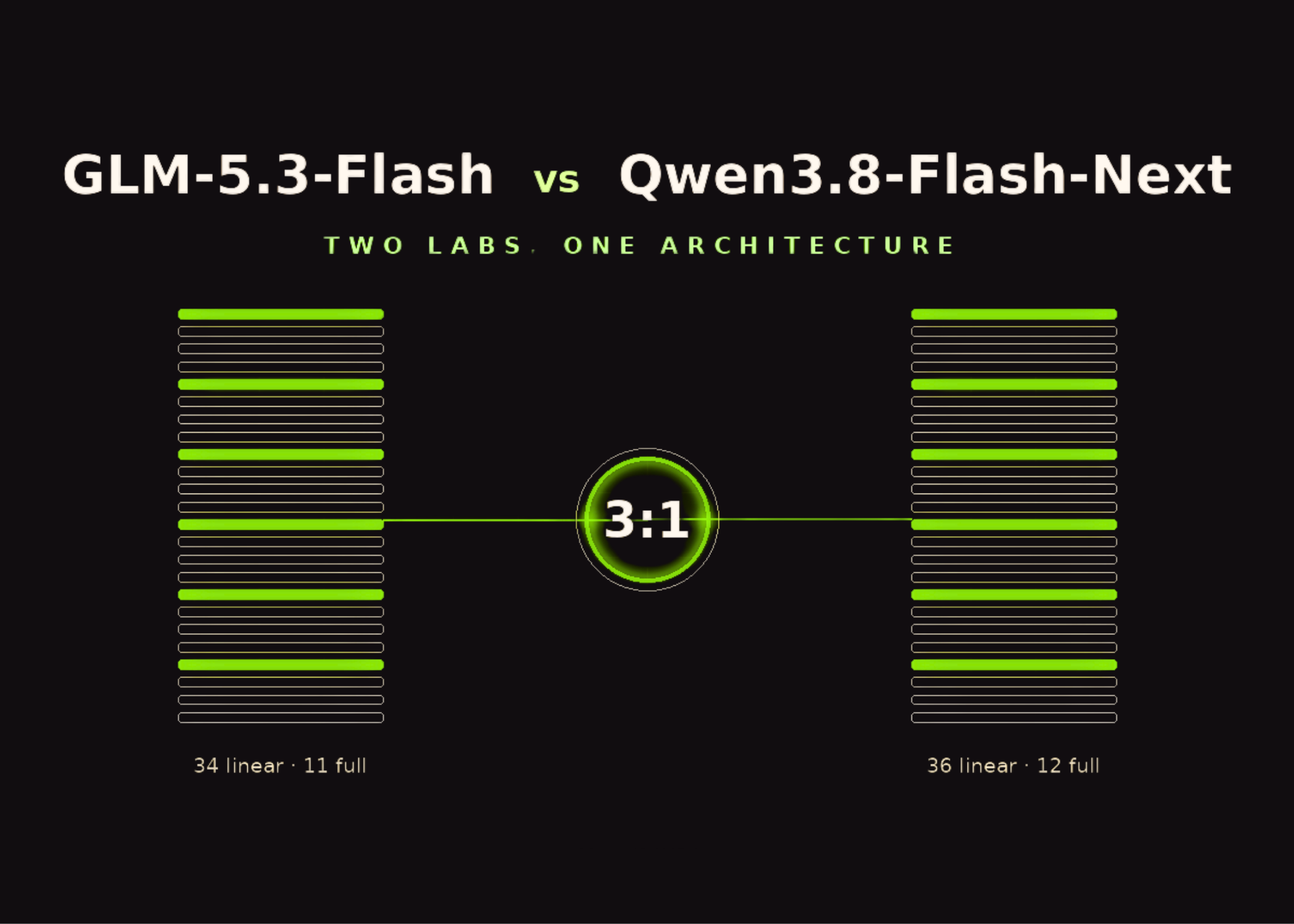
GLM-5.3-Flash and Qwen3.8-Flash-Next take a hybrid approach. Around three out of every four attention layers use a linear-attention design that stores the past in a compressed recurrent state. The remaining quarter uses fuller attention for precise retrieval. Both models therefore use a 3:1 ratio of linear to full attention, according to the source article’s analysis of their configurations.
In plain language, the model does not repeatedly reread every page in a large document. It keeps a compact memory for most information, then searches a smaller selection when it needs exact details. Both systems also compress context by four times before selecting relevant sections, and both limit the selected attention budget to 2,048 tokens.
| Model | Model size | Active parameters | Context capacity | Attention design |
|---|---|---|---|---|
| GLM-5.3-Flash | 320B parameters | 18B active parameters | 1 million tokens | 34 linear layers and 11 full-attention layers |
| Qwen3.8-Flash-Next | 125B main model plus a 51B n-gram embedding table | 6B active parameters | 262,144 tokens natively; extendable to 1 million with YaRN | 3 Gated DeltaNet layers followed by 1 sparse-attention layer |
Sources: MarkTechPost analysis; GLM-5.3-Flash model release information; vLLM Qwen architecture information.
The models also use four gated residual streams rather than one. You can think of these as four controlled pathways for passing information through the system. Gates help decide what should be retained, written or suppressed. This is designed to improve stability and reduce unwanted activation spikes.
Finally, both teams use the Muon optimiser, with fused matrices split into separate transformations before optimisation. That is a training detail, but it matters because better training efficiency can eventually translate into more capable models that are easier to serve.
The practical lesson is not “bigger models are better”. It is that careful information selection can make long-document AI more efficient without abandoning deeper reasoning.
How This Applies to Malaysian SMEs
1. Customer service can handle longer histories more effectively. Suppose you operate a renovation company, travel agency, distributor or professional services firm. A customer may have a long WhatsApp conversation covering requirements, changes, delivery dates and complaints. An AI assistant using selective context could identify the relevant commitments without treating every old message as equally important. Your staff could receive a concise summary with the latest request, unresolved issue and next action.
This does not mean you should let AI send replies without supervision. It means you can use AI to prepare a better draft, find the correct details and reduce the time spent scrolling through old conversations. You should still require human approval for refunds, contract changes, legal statements and sensitive customer commitments.
2. Internal document search becomes more useful. Malaysian SMEs often keep information across quotations, product catalogues, standard operating procedures, staff guides, supplier terms and shared drives. A conventional chatbot may retrieve a paragraph but miss the relationship between several documents. A long-context system with selective retrieval could compare a customer’s request against your latest product rules, warranty terms and delivery procedures.
For example, a food manufacturer could ask, “Which current specification applies to this customer’s order, and what documents must production complete before dispatch?” The assistant would need to identify the right product version, customer requirement and internal checklist. Your implementation should include document dates, approval status and source links so staff can verify the answer.
3. Finance and administration can benefit from structured review. Your accounts team may process invoices, purchase orders, delivery orders and payment reminders. An AI workflow could compare these records, flag a mismatch and explain which field requires checking. The model’s ability to focus on selected context may help when a supplier has a long account history, but you should treat it as a review assistant rather than an autonomous accountant.
For Malaysian operations, build rules around local tax documentation, SST treatment where applicable, company approval limits and document retention. AI should extract and classify information, while your existing accounting system remains the system of record. Make sure staff can open the original invoice or purchase order behind every generated conclusion.
4. Sales teams can prepare more relevant proposals. If you sell machinery, software, training, logistics or business services, proposal preparation often requires reviewing previous conversations, industry requirements and technical specifications. An AI assistant could identify the prospect’s priorities and draft a proposal structure using approved service descriptions. It could also compare the requested features with your actual delivery capability.
Use a controlled knowledge base for this purpose. Do not allow the assistant to invent guarantees, implementation timelines or compliance claims. Create an approval step where a manager checks every proposal before it reaches the customer.
Practical Takeaways
- Start with one document-heavy workflow: customer enquiries, quotation preparation, SOP search or invoice checking.
- Measure useful outcomes: response time, correction rate, missed details and staff review time.
- Require citations: every AI answer should point to the source document, page or message where possible.
- Separate routine and sensitive tasks: allow automation for summaries and classification, but keep human approval for contracts, HR decisions and financial commitments.
- Test long inputs: use real examples containing outdated documents, contradictory instructions and incomplete information.
- Check Malaysian language needs: test English, Bahasa Malaysia, mixed-language messages and industry abbreviations used by your customers.
- Protect access: restrict the assistant by role so a sales user cannot view confidential payroll or supplier records.
- Keep a fallback process: staff should know what to do when the AI is uncertain or unavailable.
One Important Warning: Efficiency Is Not the Same as Accuracy
MiniMax reached a different conclusion from Z.ai, Qwen, DeepSeek and Kimi. Its testing reportedly found serious weaknesses in multi-hop reasoning beyond 32K context after supervised fine-tuning, so its M2 model used full softmax attention and its M3 model adopted sparse softmax attention without linear-attention layers. That disagreement shows that there is no universally correct architecture.
Qwen also reported a specific issue with removing rotary position embeddings. Its NoPE variant showed no measurable difference during pre-training, but after post-training it sometimes failed to stop generating. This is a useful reminder for you as a buyer: a model can perform well in a technical benchmark and still behave poorly in a real workflow.
Always test the complete process, not just the model’s written answer. Check whether it stops at the right time, follows your approval rules, handles missing data and escalates uncertainty.
The Bigger Picture
The convergence between these laboratories suggests that AI development is moving towards selective computation. Models are being designed to spend more processing on the parts of a task that matter and less on repetitive context. That is particularly relevant for businesses with long records, large knowledge bases and many recurring customer interactions.
For SMEs, the benefit may appear indirectly. Software providers could offer assistants that search more documents, handle larger conversations and operate faster on practical hardware. Open-weight models may also give technology partners more flexibility when building private or industry-specific systems. The actual result will depend on deployment quality, data governance, integration and testing.
You should therefore avoid choosing an AI product solely because it advertises a large context window or a high benchmark score. Ask how it retrieves information, how it cites sources, how it handles confidential data and how your team can correct mistakes. A smaller, well-integrated assistant may be more valuable than a powerful model disconnected from your daily systems.
The best next step is simple: choose one repetitive workflow, document the current process, run a controlled pilot and compare the results against your existing method. If the AI reduces searching, drafting or checking while keeping people in control, you have found a sensible place to expand automation.
Ready to Streamline Your Operations?
Your business should run itself. AutoRunBiz deploys AI agents to automate your daily operations — WhatsApp orders, invoicing, customer follow-ups, and accounting. Book a free 15-min ops audit to see where automation fits your business →