
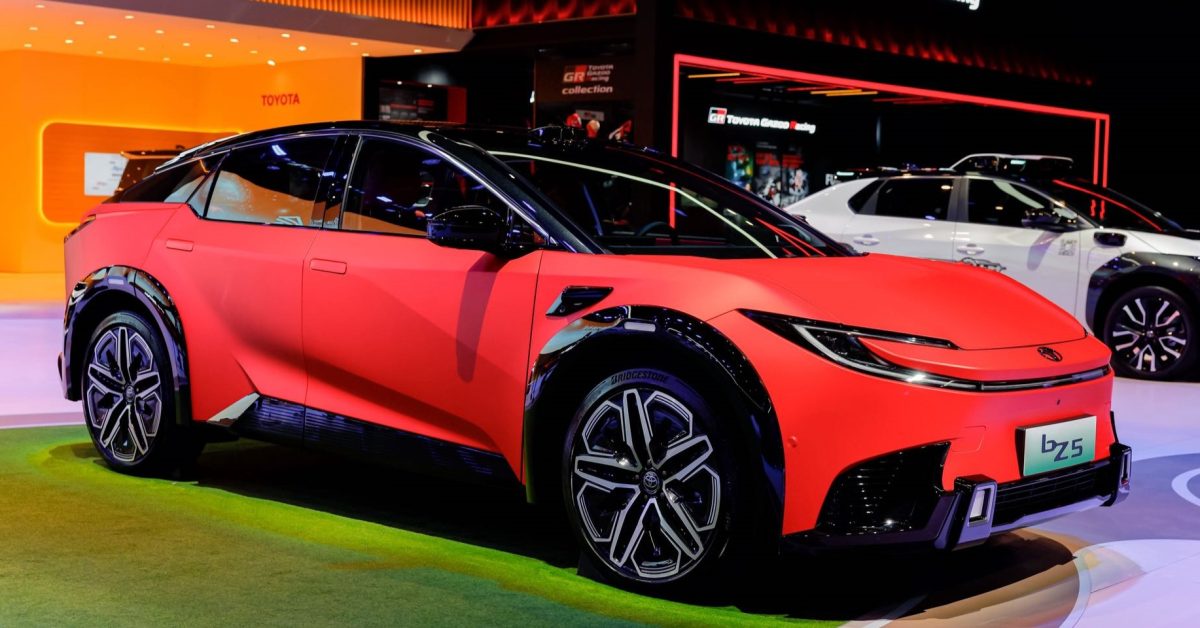
Why Toyota’s New Electric SUV Matters to Your Business
Electric vehicles are no longer competing only on environmental credentials or premium branding. Toyota’s updated bZ5 shows that established manufacturers are now combining lower-priced electric hardware with advanced software, driver assistance and connected features. For you as a Malaysian SME owner, this matters because the vehicles used by your sales team, technicians, delivery staff or management may soon be judged as much by digital capability as by fuel consumption.
According to Electrek, the refreshed 2027 Toyota bZ5 is offered in China in six variants, with regular prices ranging from 129,800 yuan to 199,800 yuan. The article reports that the SUV is positioned at roughly half the price of a Tesla Model Y in China, although prices, taxes, specifications and availability in Malaysia can differ significantly.
The important lesson is not whether you can buy this particular model locally. It is that electric vehicles are becoming more software-driven, more feature-rich and more aggressively positioned. That shift can affect how you plan transport, customer service, field operations and even your company’s technology strategy.
What Happened
Toyota’s FAW-Toyota joint venture launched the bZ5 in China in 2025 and has now introduced an updated 2027 version, according to Electrek. The refreshed SUV is similar in size to a Tesla Model Y and uses two BYD Blade battery options: 65.28 kWh and 73.98 kWh. The reported CLTC driving ranges are up to 550 kilometres and 630 kilometres respectively.
The bZ5 uses a single front-mounted electric motor producing a maximum 268 horsepower, or 200 kW, and 330 Nm of torque. Its battery can reportedly charge from 30% to 80% in 27 to 29 minutes, depending on the variant. These figures come from the manufacturer’s stated specifications and the Chinese CLTC testing cycle, so you should not assume identical real-world range in Malaysian traffic, heat, rain or highway conditions.
The major upgrade is inside the vehicle’s software. The new bZ5 uses Momenta 6.0, an advanced driving-assistance platform powered by a high-performance chip rated at 544 TOPS. It combines roof-mounted LiDAR with 32 smart sensors and supports more than 30 assistance features, including navigation assistance on complex city roads and automated parking, as reported by Electrek.
The vehicle also features a 15.6-inch central display, a digital instrument cluster and dual driver-monitoring systems for both the driver and front passenger. However, the model’s sales performance shows that specifications alone do not guarantee market success. Electrek, citing CnEVPost, reported that bZ5 sales in China fell to 529 units in the referenced month, down 64% from July 2025.
Why This Matters for Malaysian SMEs
For a Malaysian SME, the first practical implication is that vehicle ownership is becoming part of your digital operations. A connected EV can potentially provide information about location, charging status, driving behaviour, route efficiency and maintenance needs. If this information can be connected to your business automation platform, you may be able to improve dispatching, appointment planning and vehicle utilisation.
Consider a service company in Shah Alam with several technicians travelling to customer sites. Instead of assigning jobs manually through messaging apps, the business could eventually combine vehicle location, battery status and appointment data. A technician with sufficient range could receive the next nearby job, while a vehicle approaching a charging session could be excluded from urgent assignments. The bZ5’s reported driver-assistance capabilities illustrate how the vehicle itself is becoming another source of operational data.
Delivery businesses can also learn from this development. A bakery, florist, pharmacy distributor or spare-parts supplier may not need a large electric SUV, but the principle is relevant: choose vehicles based on daily routes, payload, charging access and software compatibility. The most attractive specification is not necessarily the longest advertised range. It may be the vehicle that fits your actual delivery schedule and integrates cleanly with your order-management system.
Malaysian conditions require careful evaluation. Traffic congestion in Kuala Lumpur and Petaling Jaya, long-distance routes between states, apartment charging limitations and tropical weather can all affect an EV’s usefulness. You should test realistic routes, confirm after-sales support and check whether the manufacturer provides local software updates, spare parts and warranty servicing before making a fleet decision.
| Area to Assess | Questions for Your Business |
|---|---|
| Daily routes | Can the vehicle complete normal jobs without an unscheduled charging stop? |
| Charging access | Can you charge overnight at your premises, and who will manage shared charging slots? |
| Software | Can vehicle data connect with your CRM, dispatch or field-service tools? |
| Safety | Are drivers trained to understand the limits of automated assistance? |
| Support | Is local servicing available, and how quickly can the vehicle be repaired? |
The Bigger Picture
The bZ5 points to a broader change in the automotive market: vehicle differentiation is moving from hardware alone to hardware plus software. A business vehicle may soon receive feature improvements through software updates, use artificial intelligence to assist with route decisions and monitor driver attention, and communicate continuously with your company systems.
For an SME, the key question is not simply “Which EV has the best range?” It is “Which vehicle can make our daily operations more predictable and easier to manage?”
This also changes how you should evaluate fleet purchases. A vehicle with impressive sensors is not automatically suitable for commercial work. Driver-assistance functions should support human judgement, not replace it. Malaysia’s roads include motorcycles, sudden lane changes, heavy rain, construction zones and inconsistent markings. Any automated driving feature must be treated as assistance, with trained drivers remaining responsible for the vehicle.
You should also separate confirmed local facts from international headlines. The updated bZ5 described by Electrek is a China-market model, and the source reports that it is not available in the United States. That does not confirm Malaysian availability. Before acting on a global launch story, check official Malaysian distributor announcements, vehicle certification, warranty terms, charging compatibility and local service coverage.
What You Can Do Now
Start with a simple fleet audit. Record each vehicle’s daily distance, idle time, common routes, driver and maintenance issues for at least several weeks. Mark where vehicles normally stop and whether overnight charging could be installed at your premises. Then identify which information your team currently tracks manually, such as mileage, job completion, fuel or charging status and driver location.
Next, speak with your automation provider about whether your CRM, accounting platform or field-service system can support vehicle-related workflows. You could create alerts for overdue maintenance, low battery before a scheduled job, missed appointments or excessive idle time. Even if you continue using petrol or diesel vehicles, these workflows can improve operations today.
Toyota’s updated bZ5 is a global signal rather than an immediate instruction to replace your fleet. Its combination of electric driving, advanced sensors and connected software shows where commercial mobility is heading. By preparing your data, processes and staff now, you will be in a stronger position to choose the right vehicle when suitable models and support become available in Malaysia.
Ready to Streamline Your Operations?
Technology moves fast. Your operations should keep up. AutoRunBiz builds AI systems that run your daily workflows — from WhatsApp order capture to accounting. Book a free 15-min ops audit →