
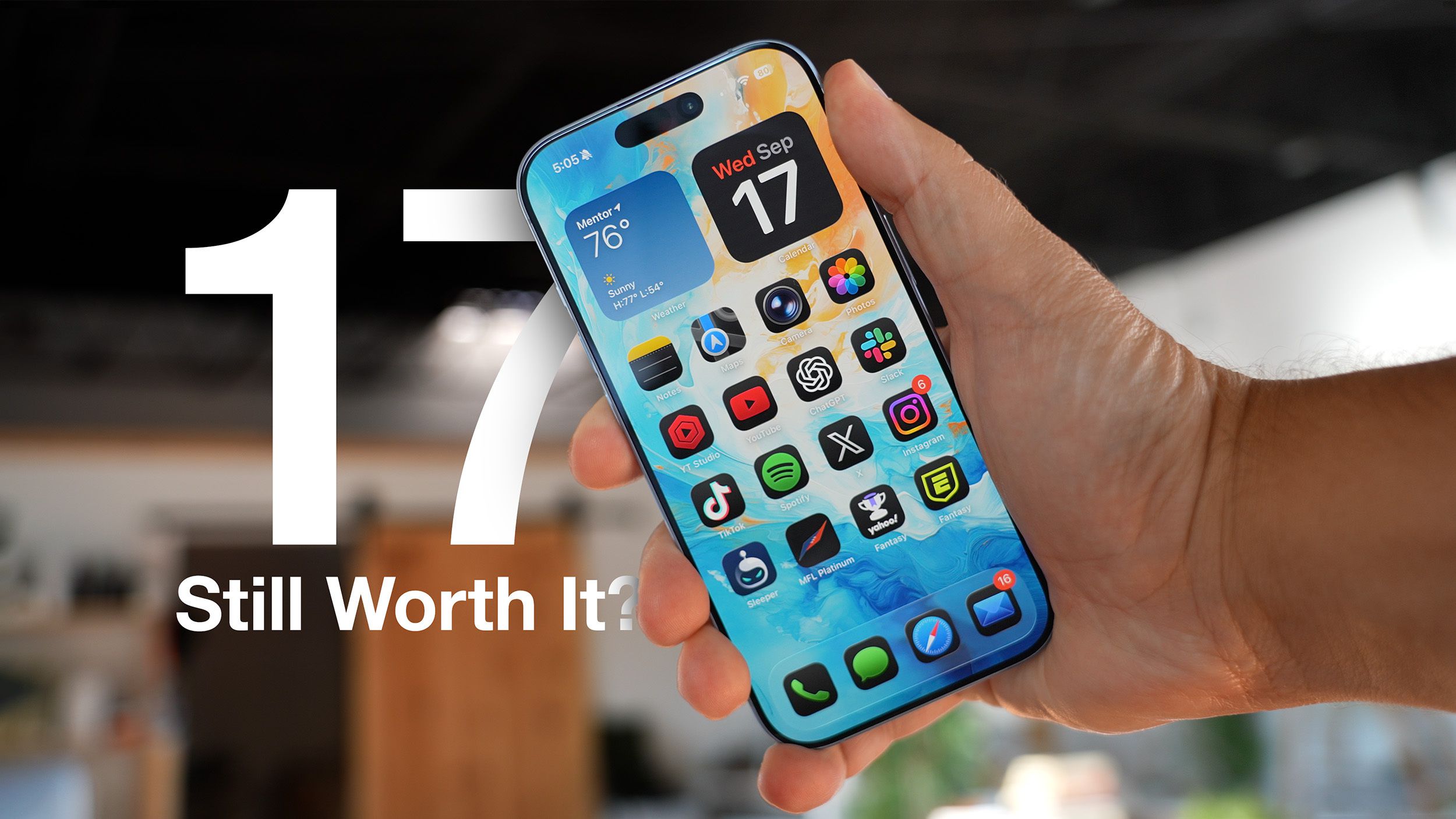
Your Team’s Phones Are Work Tools — Here’s How to Time the Upgrade
You run a small business in Malaysia. Your phone is probably not a toy — it’s the device your team uses to answer WhatsApp Business messages at 9pm, scan DuitNow QR payments at a pop-up booth, snap product photos for your online store, and hotspot the laptop when the office WiFi drops during a client call. So when Apple’s launch cycle gets weird, it’s not just gadget news. It’s a decision that affects your workflow, your staff’s productivity, and your equipment budget.
Here’s the situation: for the first time in years, Apple is changing its release rhythm. The usual “new standard iPhone every September” pattern is broken, and that leaves business owners like you stuck between two options — buy the current iPhone 17 now, or hold out for something that may not arrive until 2027. Let’s break down what actually matters for a Malaysian SME owner, without the hype.
TL;DR
- The standard iPhone 18 is not launching this September — only the Pro models and a new foldable “Ultra” are coming first, with the base model delayed to spring 2027 per MacRumors.
- The iPhone 17 is still a strong, reliable device that MacRumors recommends for most people in its 2026 buyer’s guide.
- For most SMEs, the smarter move is to buy the iPhone 17 when you actually need it — not to wait months for rumoured features your team may never use.
What This Means (In Plain Language)
Apple usually releases a standard and a “Pro” iPhone together every September. Not this time. According to MacRumors, the fall launch slate includes only the iPhone 18 Pro, iPhone 18 Pro Max, and a foldable iPhone Ultra. The cheaper, standard iPhone 18 is being pushed to spring 2027.
Why does this matter to you? Because it changes the usual buying logic. In a normal year, you’d wait for the new launch and grab the previous model at a discount. But that may not happen this time. TrendForce analysis cited by MacRumors suggests Apple could actually raise prices on existing models like the iPhone 17 when the new Pros arrive. Translation: waiting might not save you a single sen.
There’s also a quality angle. Rumours reported by MacRumors point to Apple possibly using a cheaper, less bright screen and lower-quality A20 chips in the standard iPhone 18, with components borrowed from the budget iPhone 18e. That means the “wait for the better phone” logic may be backwards — the current iPhone 17 could actually be the better-built device.
How This Applies to Malaysian SMEs
Let’s get practical. Your business doesn’t run on spec sheets — it runs on reliability. If your sales team is out in Petaling Jaya visiting clients all day, they need a phone that holds a charge, takes decent photos of receipts and site conditions, and doesn’t crash during a video call. The iPhone 17 already ticks those boxes: it has the same 120Hz ProMotion display, Always-On screen, and the same main and ultra-wide cameras as the iPhone 17 Pro. For a field worker, that’s genuinely all they need.
Think about your trade-in timing. If your company has a policy of replacing staff phones every two to three years, the worst thing you can do is hold onto an ageing device through this launch period. MacRumors notes that trade-in values drop with every new iPhone launch. That’s true whether you’re trading in a business-owned iPhone or letting staff trade in their personal devices under a bring-your-own-device arrangement. If you know a phone is due for replacement, doing it now — before prices potentially rise and before your current device depreciates further — is the kind of small decision that keeps your equipment budget predictable.
And then there’s the software question. Malaysian SMEs run on WhatsApp, so your phone needs to handle the apps your business depends on. MacRumors reports that the iPhone 18’s RAM upgrade is uncertain — analyst Ming-Chi Kuo says it may get only 9GB, which would not support the new Siri voice customisation and dictation features in iOS 27 that require 12GB. The iPhone 17 doesn’t have 12GB either, so you’re not missing out by buying now. But here’s the real point: do any of your staff actually depend on Siri voice dictation to run your business? Probably not. Don’t let a speculative feature delay a purchase your business needs today.
Consider the practical use cases that matter in Malaysia specifically. If you run a food and beverage outlet, your staff use phones for Grab and foodpanda order tablets, QR code scans, and shift scheduling. If you’re in e-commerce, your phones are your content studio — product photography, live selling on TikTok or Shopee, and replying to customer DMs. None of the rumoured iPhone 18 upgrades — a 24-megapixel selfie camera, a smaller Dynamic Island, or the C2 modem for faster connectivity, as reported by MacRumors — are going to meaningfully change how you live-sell or respond to a customer who’s asking whether you have stock in KWSP brown.
A phone your team actually uses daily is worth more than a phone that merely exists on a rumour list. Don’t let a speculative launch window hold your operations hostage.
Comparing Your Two Paths
| Factor | Buy iPhone 17 Now | Wait for iPhone 18 (Spring 2027) |
|---|---|---|
| Timeline | Available immediately | Roughly 6+ months extra wait per MacRumors |
| Trade-in value | Your current device is worth more now than later | Trade-in prices drop when new models launch |
| Build quality | Solid, proven components | Possible cost-cutting on screen and chip quality per rumours |
| Key features | 120Hz display, Always-On, same main cameras as Pro | Possible 24MP selfie cam, smaller Dynamic Island, C2 modem (all unconfirmed) |
| Software support | Will receive iOS updates for years; iOS 27 features that need 12GB RAM excluded either way | Likely 9GB RAM per Ming-Chi Kuo — may also miss those features |
Practical Takeaways
- Buy now if a phone is due for replacement. Your staff’s current devices won’t gain value by waiting — their trade-in value only drops.
- Don’t wait for rumoured AI features. The iOS 27 Siri improvements reportedly need 12GB RAM, and even the iPhone 18 may only get 9GB per Kuo’s analysis. If your team doesn’t use Siri today, they won’t miss it.
- Equip your field team with the iPhone 17. It has the same display and primary cameras as the Pro models, which matters more for frontline staff than a telephoto lens.
- Review your device replacement cycle. If you run a two-year cycle, map out when each staff phone is due. A staggered, planned replacement schedule beats a panic purchase when a phone dies mid-week.
- Consider the foldable cautiously. The iPhone Ultra is new territory. For a business, you want proven reliability, not first-generation form factor risks.
The Bigger Picture
This unusual launch schedule tells you something larger about how Apple is shifting its strategy. By separating the standard iPhone from the Pro line — and adding a premium foldable — Apple is pushing a clearer three-tier structure. For your SME, that means future buying decisions will require more deliberate planning, not just an annual upgrade reflex.
The long-term lesson is not about which iPhone to buy. It’s about treating your company’s devices as infrastructure. Just like you wouldn’t replace your POS system based on a rumour, you shouldn’t hold off on a needed phone upgrade because of an unconfirmed spec. The iPhone 17 is the device MacRumors recommends for most people in 2026, and for good reason: it delivers the features your team actually uses, at a sensible time in the product cycle.
Make the call based on what your business needs this quarter — not on what Apple might announce next year. If a staff member is struggling with an old phone that dies before lunch, replacing it with an iPhone 17 today is an investment in their productivity. In business, a device in hand — powered on, charged, and ready for the morning briefing — is always worth more than a promise waiting on a rumour mill.
Ready to Streamline Your Operations?
Your business should run itself. AutoRunBiz deploys AI agents to automate your daily operations — WhatsApp orders, invoicing, customer follow-ups, and accounting. Book a free 15-min ops audit to see where automation fits your business →