
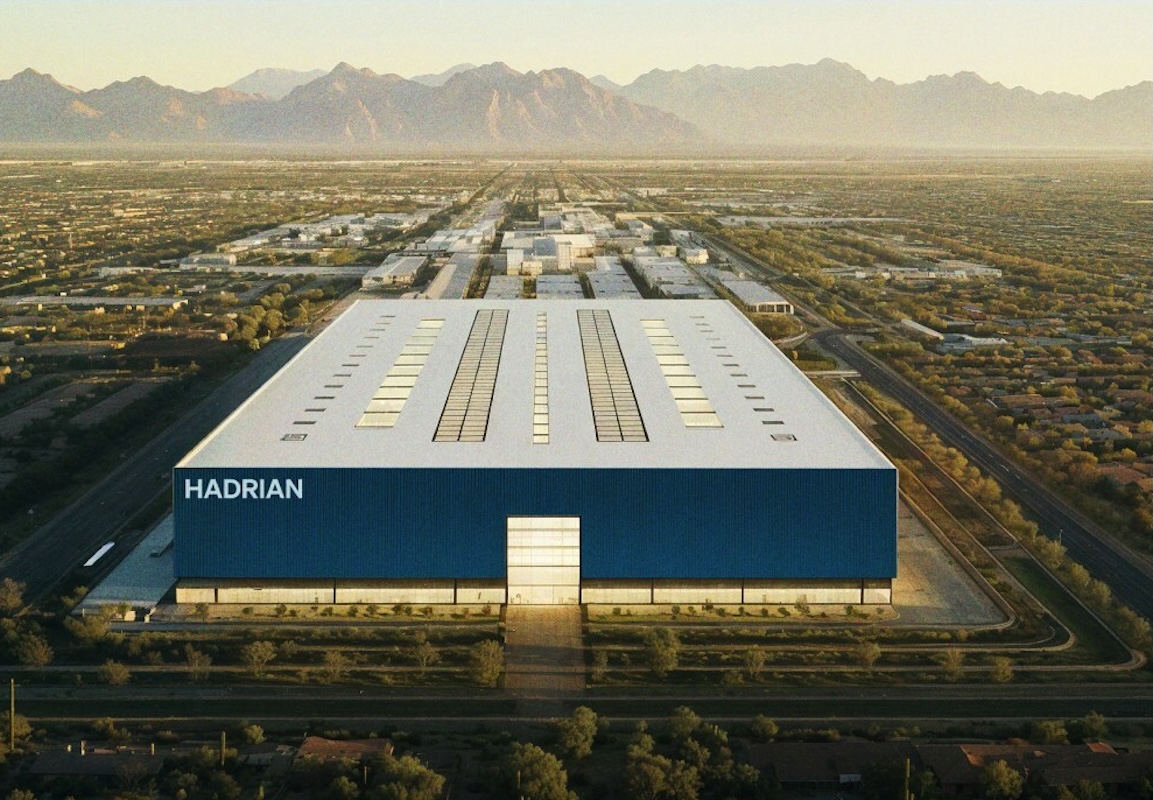
When “boring” manufacturing gets billions, it’s time to look closer
You run a business that makes things or supports those who do. Maybe you’re a precision machining workshop in Penang, a plastics injection moulding supplier in Johor, or an electrical components contract manufacturer in Selangor. You’ve heard the hype about artificial intelligence, cloud computing, and “digital transformation” for years. Meanwhile, your day-to-day is about meeting delivery deadlines, keeping tolerances tight, and managing a workforce that’s getting harder to hire.
Then you read that a company called Hadrian raised $1.37 billion to build automated factories that mass-produce parts for submarines and military vehicles. Not robots with AI brains. Not software that writes code. Just factories that make metal parts faster, more precisely, and at scale. And investors valued that idea at nearly $8 billion. According to TechCrunch, the fresh round was led by WCM Investment Management, Washington Harbour Partners, Valor Equity Partners, 137 Ventures, and Baillie Gifford, with participation from names like Andreessen Horowitz, Founders Fund, and Lux Capital. That’s a mile-long list of the world’s most sophisticated investors.
Why should a Malaysian SME owner care? Because this tells you exactly where the global market is heading. It says that the value isn’t in flashy new technology alone—it’s in using technology to do the unglamorous work of manufacturing reliably and profitably. And that’s a game you can play, too.
TL;DR
- Hadrian’s business model is straightforward: build highly automated factories that make precision parts for existing military platforms—no flashy new weapon systems required.
- The $1.37B round at a $7.87B valuation proves that investors reward companies that solve real, boring supply chain problems with automation and disciplined execution.
- For Malaysian SMEs, the lesson is to identify your most repetitive, high-skill, or high-volume production tasks and automate them incrementally—starting with one machine or one line, not a whole factory.
What This Means: The $8 Billion Part-Maker
Hadrian is not trying to invent a flying car or a killer robot. It’s building automated manufacturing facilities that produce parts for vehicles the military already uses—like submarines. In March 2026, the company opened a facility in Alabama to mass-produce submarine parts, making that its fourth facility. The deal, structured as a public/private partnership, was valued at $2.4 billion, according to Hadrian’s announcement. So we’re not talking about a lab experiment. We’re talking about physical factories, with real contracts, doing real work.
The company had previously raised a $260 million Series C led by Founders Fund and Lux Capital about a year before this latest round. Combined with the new money, Hadrian has raised roughly $2 billion in total, based on PitchBook estimates. That’s an enormous amount of capital for a company whose core promise is “we make parts more efficiently.”
Why? Because the defense world has a huge problem: its supply chain is fragmented, slow, and full of small machine shops that can’t scale. Hadrian’s automation approach lets it take on large contracts, deliver consistent quality, and ramp output quickly. Investors see that as a massive opportunity—not because automation is trendy, but because it fixes a business problem with a clear customer and a painful gap in the market.
“The breakthrough isn’t AI or a new material. It’s the quiet, disciplined application of automation to a supply chain that hasn’t changed in decades. That’s where the billions are flowing.”
How This Applies to Malaysian SMEs
Malaysia is a manufacturing powerhouse. We’re integrated into global supply chains for electronics, automotive components, medical devices, and even aerospace parts. Many of our SMEs are precision engineering shops with 10 to 50 employees, skilled machinists, and a handful of CNCs. You’ve probably seen demand grow for higher mix, lower volume orders, or premium precision work. Also, you’ve likely felt the pressure of rising labour costs and a shortage of skilled technicians. That’s exactly the environment where Hadrian’s model — automate the repetitive, high-precision work — can be adapted to your scale.
You don’t need a $1.37B war chest to start. Consider your production floor. Which parts have the highest repeat demand? Which processes are bottlenecked by manual loading, measuring, or inspection? That’s your first automation target. For example, a 20-person machining shop in Penang could invest in a robotic machine-tending arm for one machining centre. The cost of that is far lower than many business owners assume, and it lets your most experienced machinist focus on setups and programming instead of standing there watching a cycle run. It’s a small step, but it’s the same logic Hadrian uses: take the human out of the monotonous loop, increase throughput, keep quality consistent.
Then look at your customer relationships. Hadrian’s public/private partnership with the state of Alabama shows that governments and large prime contractors are willing to make long-term arrangements with suppliers who can prove reliability at scale. In Malaysia, government-linked companies and multinationals operating here are increasingly under pressure to build resilient local supply chains. If you can show that your shop has automated cells and digital tracking, you become a more credible partner for bigger contracts. The question your customer silently asks is: “Can you handle double the volume without doubling the headcount?” An automated line answers yes.
There’s another, deeper point. Hadrian didn’t go after a brand new industry. It went after defence manufacturing because that’s where the pain is intense and the customers are desperate for capacity. As a Malaysian SME, look at the industries around you that are underserved. Are there components for grid infrastructure, utility maintenance, or public transit that are still imported because local supply can’t guarantee speed and precision? That’s a potential niche. You don’t have to be the biggest — you have to be the most reliable. And reliability, today, increasingly comes from automation, not just worker skill.
Practical Takeaways You Can Act On
- Audit your repeat tasks. List your top five best-selling products or components. Identify the manual steps in their production. Those are your initial automation candidates.
- Start with one machine. A simple robotic loader, an automated inspection station, or even a digital job-tracking screen can make a real difference before you think about a “smart factory.”
- Use digital records as a selling point. When you pitch to bigger customers, show them data on machine utilisation, quality rejection rates, and delivery times. That builds trust far faster than a flashy brochure.
- Explore public/private partnership models. In Malaysia, agencies like MIDA and various state development corporations have programs to help SMEs adopt automation. Don’t assume those are only for large companies.
What the Numbers Tell Us
| Milestone | Amount / Value | Purpose / Context |
|---|---|---|
| Latest funding round | $1.37 billion | Equity raise at $7.87B valuation, led by major institutional investors |
| Previous Series C (approx. 1 year earlier) | $260 million | Led by Founders Fund and Lux Capital |
| Total raised to date | ~$2 billion | PitchBook estimate |
| New Alabama facility | $2.4 billion (public/private partnership) | Mass production of submarine parts; fourth facility |
Source: TechCrunch article on Hadrian’s funding
The Bigger Picture: Automation Becomes a Strategy, Not a Project
What’s really happening here isn’t just about defence tech. It’s about capital markets recognising that automation is a business strategy, not a cost centre. For decades, manufacturing automation was viewed as an expense justified by labour savings. Hadrian’s valuation suggests the market is shifting to reward companies that use automation to increase capacity, shorten lead times, and win new contracts. That logic applies as much to a Malaysian SME as to a US defence supplier.
Long-term, this trend will squeeze every manufacturing business. Customers will expect faster turnarounds and more consistent quality. Meanwhile, the talent crunch isn’t going away. The only way to stay competitive is to make your factory more productive per worker than the next factory down the road. The good news is that you don’t have to match an $8B company. You just have to be a little more automated than you were last year—and a lot more than your competitors.
So the next time you read about a massive funding round for a company making parts, don’t dismiss it as a world away. Someone just paid billions to prove that a factory like yours—if run with ruthless focus on automation and customer needs—can be worth far more than its machines. The blueprint is there. The only question is how quickly you’ll start writing yours.
Ready to Streamline Your Operations?
Your business should run itself. AutoRunBiz deploys AI agents to automate your daily operations — WhatsApp orders, invoicing, customer follow-ups, and accounting. Book a free 15-min ops audit to see where automation fits your business →