
Cameras Alone Might Not Cut It—What That Means for Your Business Stack
When you’re running a small business in Malaysia, every new tech pitch sounds the same: “Pick this one tool, and it will solve everything.” It is fast, it is simple, and the demo looks flawless. But the ongoing battle between Waymo and Tesla over self-driving sensors tells a very different story—one that has direct implications for how you choose your automation software, hire your team, and build your processes.
The debate recently boiled over when Waymo co-CEO Dmitri Dolgov explained exactly why Tesla’s camera-only approach hits a safety ceiling long before it can ever reach full autonomy (Electrek). He didn’t call out Tesla by name, but he didn’t have to. Camera-only is Tesla’s entire bet, and this was a direct shot at it.
What Happened
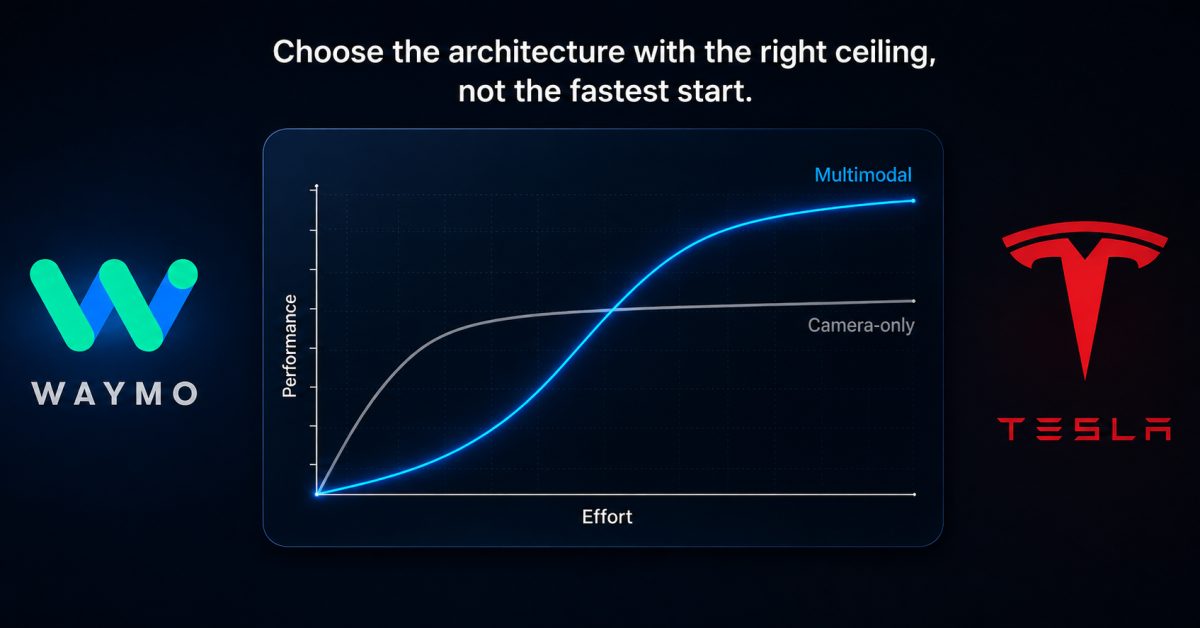
Dolgov, speaking at Y Combinator’s Startup School, walked through two decades of Waymo’s lessons in building a fully driverless car. His core argument: humans drive with just eyes, so cameras can absolutely match human performance or power a driver-assist product. But he said that if you are targeting truly autonomous driving with “strongly superhuman performance,” you will find that “weak sensing just leads to a safety curve that flattens out way too early” (Electrek).
That is the whole argument in a few sentences. Cameras are passive, he explained, and they degrade in darkness, glare, and dust storms. Waymo pairs cameras with lidar, which directly measures 3D structure, and radar, which punches through rain and fog and reads velocity directly. These are not backups to each other—each sensor runs its own encoder, and the data fuses into a single view that Dolgov says is “vastly superior to what you get with any one sensor” (Electrek).
He backed it with real failure cases. In a Phoenix dust storm, the camera sees almost nothing while lidar cleanly picks out a pedestrian at the roadside. A single leaf covering a sensor can bring a camera-only robot to a full stop, while Waymo’s multi-sensor design allows it to safely drive back to the depot (Electrek).
Why This Matters for Malaysian SMEs
You might think this is a US tech story with no bearing on your Malaysian SME. Read it again. If you are automating any part of your business—whether it is a customer relationship management system, an inventory management tool, or an AI chatbot for customer service—you are going to face the same choice. Do you pick the single, fast, simple solution that demos incredibly well? Or do you build a system with multiple layers and redundant checks that can handle the unexpected?
In Malaysia, the “unexpected” is everywhere. Your delivery fleet hits an unseasonal flood in Kuala Lumpur. Your B2B order form crashes on a data-heavy day because you used a single lightweight plugin. Your support chatbot fails on a common Bahasa Malaysia dialect because it was trained only on English data. A camera-only approach to your business would tell you the demo worked fine, so the system is fine. But a robust approach asks: what happens when the data gets messy, when the lighting is bad, or when a leaf covers the lens? Dolgov’s argument suggests that if you want your company to run without you constantly watching it, you need more than one way to see the world.
There is also the “nines” problem. Dolgov described reliability as an “exponential ladder of nines.” Going from 90% to 99% is the easy part. Each additional nine of reliability—from 99% to 99.9%—takes roughly ten times more effort (Electrek). Tesla’s approach has spent years on the steep, easy part of that curve. Its robotaxi data currently shows a crash rate about three times worse than human drivers, even with a human safety monitor in the front seat (Electrek). Waymo, meanwhile, has logged 220 million rider-only miles with 94% fewer serious-injury crashes than human drivers—roughly 17 times better (Electrek).
Now translate that to your SME. If your invoicing system only works 99% of the time, that means one out of every hundred invoices fails. For a small business sending 2,000 invoices a month, that is 20 angry customers. Getting to 99.9% might take ten times the engineering effort—but for an automated system running without direct supervision, that last nine is the entire point. The camera-only approach gives you a fast, early ramp. The multi-sensor approach gives you a system that can actually be left alone.
The Bigger Picture
There is a tempting criticism that Waymo’s approach relies on sophisticated, exotic hardware. Tesla and its fans have long used this argument, often saying lidar is “a fool’s errand.” Dolgov pushed back by pointing out that Waymo is on its sixth generation of hardware, and each generation has drastically improved efficiency. Betting against lidar based on today’s manufacturing constraints, he warned, means betting on “a number that has a fairly short shelf life” (Electrek). The same is true in business technology. The simple solution you pick today will not stay simple forever—and the robust solution you avoided may become far more accessible tomorrow.
What should a Malaysian SME owner actually take away from this? First, do not extrapolate from a small, geo-fenced demo. Tesla confirmed it has accumulated just 380,000 driverless miles in the past year, while Waymo’s driverless service does that in a single day (Electrek). That 380,000 miles was in limited areas with low speeds and in a state that allowed it to operate without full autonomy. When someone demonstrates a powerful automation tool for your business on a clean, simple sample, ask yourself: does it work when your data is dirty, when your customers behave unpredictably, and when network outages hit? A demo in a geo-fenced area is not proof of real-world readiness.
“Weak sensing just leads to a safety curve that flattens out way too early.” — Waymo co-CEO Dmitri Dolgov (Electrek)
Second, redundancy is not inefficiency—it is resilience. Dolgov made the point that Waymo’s different sensors are not backups for each other; they are complementary modalities that create a single, vastly superior view (Electrek). For your SME, this means integrating multiple systems and cross-testing them. Let your accounting software talk to your inventory system. Let your CRM flag when a customer’s behavior deviates from the norm. Do not rely on a single source of truth for any critical decision.
Key Takeaways for Your SME
| Waymo’s Approach | Tesla’s Approach | What It Teaches You |
|---|---|---|
| Cameras + lidar + radar | Cameras only | Don’t bet the business on one input source |
| 220 million rider-only miles | 380,000 driverless miles | Look for proof at scale, not demos |
| 94% fewer serious-injury crashes than humans | 3x worse crash rate than humans | Safety and reliability are not marketing claims |
| Multi-sensor data fusion | Single-sensor deep learning | Integrate complementary systems for a fuller picture |
In the end, this story is not just about cars. It is about the choices you make when building the automated layers of your business. The world will keep telling you that one clean tool is enough. But if your business must function reliably when you are not in the driver’s seat, you need the sensors you cannot see—the backups, the redundancies, and the final nines of reliability that separate a demo from the real thing.
Malaysian SMEs have a unique opportunity to learn from this battle without paying the price of a robotaxi fleet. The next time you evaluate an automation vendor, ask them how they handle the “dust storm” in your industry. Ask them what happens when a leaf covers the lens. Their answer should determine whether you let them take the wheel.
Ready to Streamline Your Operations?
Technology moves fast. Your operations should keep up. AutoRunBiz builds AI systems that run your daily workflows — from WhatsApp order capture to accounting. Book a free 15-min ops audit →