
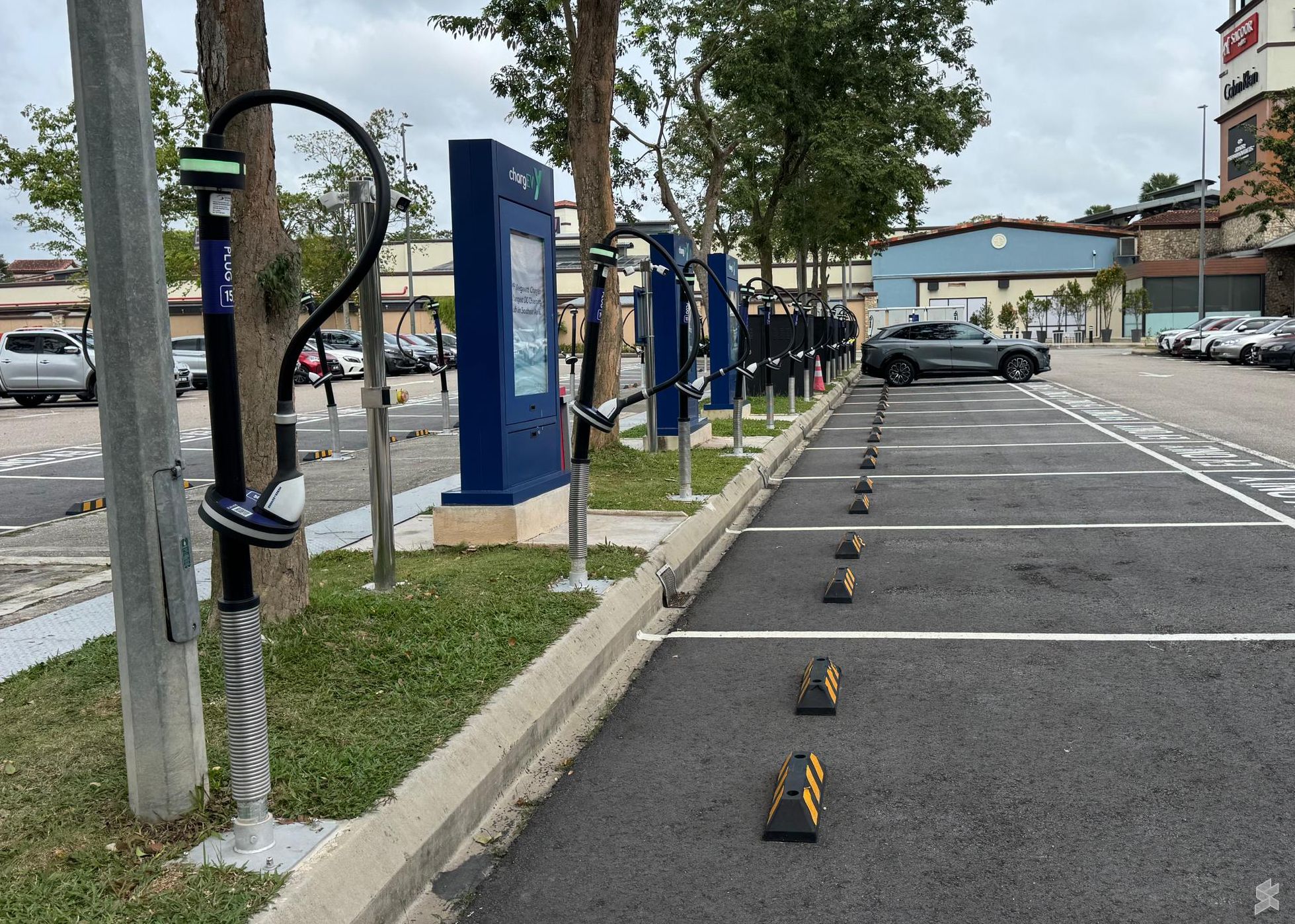
The levy is coming. The chargers still aren’t.
You’ve been thinking about adding an EV to your fleet. Maybe a delivery van for your Klang Valley routes, or a company car for your sales manager who drives to Penang twice a month. The operating numbers look good on paper — less fuel, less maintenance, fewer moving parts. Then you see the news about a proposed EV levy, and you wonder: is the government about to tax away the advantages before you even get started?
The levy isn’t your real problem though. The real problem is what happens when your driver pulls into a charging bay with 12% battery left and finds the unit offline. Again. Or when the only working charger within 20km is at a hotel that restricts access to guests. Or when a delivery route that should take four hours takes six because of charging detours.
The proposed levy, as reported by SoyaCincau, misses exactly this point. It treats EV adoption as a collection problem for the government, when the actual bottleneck for businesses like yours is a charging network that cannot yet support commercial reliance.
TL;DR: The proposed EV levy adds a fee on electric vehicles to recover the shortfall from declining fuel tax collection. It doesn’t fix the three things that actually stop Malaysian SMEs from going electric: chargers that break, chargers that aren’t where you need them, and no operator accountability for either. For business owners, the practical decision isn’t about the levy — it’s about whether an EV can complete your daily routes without stranding your team. For many routes in 2026, that answer is still no.
What This Means
The proposed levy is a straightforward idea with a straightforward flaw. As fuel-powered vehicles decline, fuel tax collection drops. The government needs a way to keep road users contributing to public finances, and an EV levy is the obvious candidate. That logic holds.
But the logic falls apart when you look at what the levy actually accomplishes. According to the SoyaCincau report, the proposal exists in a policy vacuum. It doesn’t come with a plan to fix charger uptime, expand coverage along major business corridors, or hold charging operators accountable for non-functional units. It’s a collection tool, not an infrastructure strategy.
You can attach a levy to every EV sold in Malaysia, and you still haven’t solved the problem of a driver stranded at 11pm with three broken chargers and a dying battery. The fee isn’t the friction point — the network is.
How This Applies to Malaysian SMEs
Large corporations can shelter themselves from the public charging network. They build private depots, install their own bays, and negotiate directly with property owners. You, running a business with 8 or 15 or 40 employees, cannot. You depend on the public network — and the public network is not dependable. That makes this issue fundamentally an SME issue.
Consider a food delivery operation in George Town. Riders on four-hour shifts, scooting between hawker centres and residential blocks. An electric two-wheeler or small van would dramatically cut fuel consumption. But riders don’t have time to hunt for chargers mid-shift. Every 20 minutes spent searching for a working bay is 20 minutes a customer isn’t receiving their order. The levy adds a known obligation. A broken charger adds unknown delays — delayed deliveries, frustrated customers, and riders stuck with a flat battery.
Or a technical services business sending engineers across Selangor and Negeri Sembilan. Your team covers 120km a day, visiting four to six client locations. An EV with a 300km range should work on paper. In practice, your engineer needs a top-up, and the charger on the route is in a shopping mall — occupied by a car that’s been parked there for three hours without charging. The levy is predictable. The charging roulette is not.
For an SME, the difference between a levy and a broken charger is the difference between a known obligation and a random operational disruption. One you can plan around. The other will keep you guessing.
There’s a third angle: business owners who would install their own chargers. Many SMEs own their premises or hold long-term leases. Two AC chargers in your own parking bay would eliminate most of your fleet’s dependency on the public network. But the policy conversation — focused on taxing EVs rather than enabling their operation — does little to encourage this. The levy debate signals that the government is still looking at EVs as a collection point, not as a business reality.
What the Levy Gets Wrong (and Right)
To be fair, the levy isn’t baseless. EVs still use roads, and heavier battery packs create more wear. Other countries have similar mechanisms. The problem is timing and priorities: proposing a fee before the charging network reaches basic reliability is like collecting tolls for a bridge that hasn’t been built.
| # | Problem the Levy Ignores | What It Looks Like for Your Business |
|---|---|---|
| 1 | Charger reliability | Driver arrives at a bay with 10% battery; the unit is offline. Recovery takes 45 minutes. |
| 2 | Uneven distribution | KL and Penang have reasonable coverage; the Perak stretch of the North-South Highway is a gamble. |
| 3 | No operator accountability | Charging operators face no consequences for downtime, so broken units stay broken for weeks. |
None of these three problems are addressed by a levy. And none of them will be resolved by charging EV owners more — they’ll be resolved by imposing uptime standards, expanding coverage along commercial corridors, and giving operators a reason to keep every unit working.
Practical Takeaways
Here’s what you can do with this information. No policy waiting required.
- Audit the routes before you buy. Before committing to an EV, drive the exact routes your vehicles run. Note every charger you see. Then check the charging apps to see which ones are reported as operational this week — not last month.
- Model the levy separately from charging risk. The levy is a fixed obligation you can calculate. Charging failures are variable events you must also plan for. Most owners I know factor in the first but ignore the second.
- Invest in your own charging point. If you own your premises, get a quote for two AC chargers. Overnight charging for a return-to-base fleet removes most of your exposure to the public network.
- Respond to public consultations. When the government opens the EV levy for feedback, submit your experience. Ten business owners saying “our drivers can’t find working chargers” changes more than you think.
- Run a hybrid fleet for now. Keep petrol vehicles on long-distance or time-critical routes. Pilot one or two EVs on predictable urban routes where you control charging. Reassess quarterly.
The Bigger Picture
The levy debate tells you something important about the direction of EV policy in Malaysia: it’s focused on collection, not on operational readiness. That’s a signal worth reading carefully. The fact that EVs are being considered for a levy at all means adoption has grown to a meaningful scale — which is actually progress.
But the sequencing is wrong. A charging network that businesses can rely on is the precondition for the EV adoption that makes a levy viable. Put the levy before the infrastructure, and you slow adoption — which then makes the levy less productive than planned. You get a tax with no network, and a network with no urgency.
For you, the long-term implication is practical: watch what the government does with whatever the levy generates. If the collections go toward grid upgrades, charger reliability standards, and mandated uptime reporting, then the levy becomes a sensible contribution to a maturing market. If they disappear into general government spending, then the policy is failing the exact businesses it claims to support — and you’ll know to keep planning around the infrastructure you have, not the one you were promised.
Watch the chargers, not just the headlines. When your drivers can complete a full day’s route without a backup plan, that’s the moment EVs become a clear business decision. The levy is just noise until that day arrives.
In the meantime, make your decisions based on what your team actually experiences on the road. The levy will be debated, adjusted, and possibly implemented. The charging network will gradually improve. The business case for your fleet will change with both — but it will be determined far more by the second than the first.
Ready to Streamline Your Operations?
Your business should run itself. AutoRunBiz deploys AI agents to automate your daily operations — WhatsApp orders, invoicing, customer follow-ups, and accounting. Book a free 15-min ops audit to see where automation fits your business →