
Your Business Doesn’t Run in a Vacuum. Now Your AI Won’t Either.
You know the drill. You pay a freelancer or ask your junior to write a script for your WooCommerce store or a small automation for your SQL accounting system. They show you a demo. It works perfectly on their MacBook. Then they deploy it to your live server. Suddenly, the date formats flip for Malaysia time (MYT), the API keys can’t fetch the right data, and the integration with your old legacy inventory system just crashes hard.
This disconnect between “code that works” and “code that works in your actual environment” is the single biggest operational drag on SME tech adoption today. And it is the exact problem the team behind the new KAT-Coder-V2.5 model set out to solve at the infrastructure level.
What Happened: The AI That Built Its Own Sandbox
The KwaiKAT team at Kuaishou released KAT-Coder-V2.5, a model that fundamentally changes the goalposts for agentic coding. Instead of simply generating code based on a prompt and hoping for the best, this model is trained to operate inside real, executable repository environments. It doesn’t just write the function; it builds the entire scaffolding needed to verify that the function actually runs as intended in a specific setup.
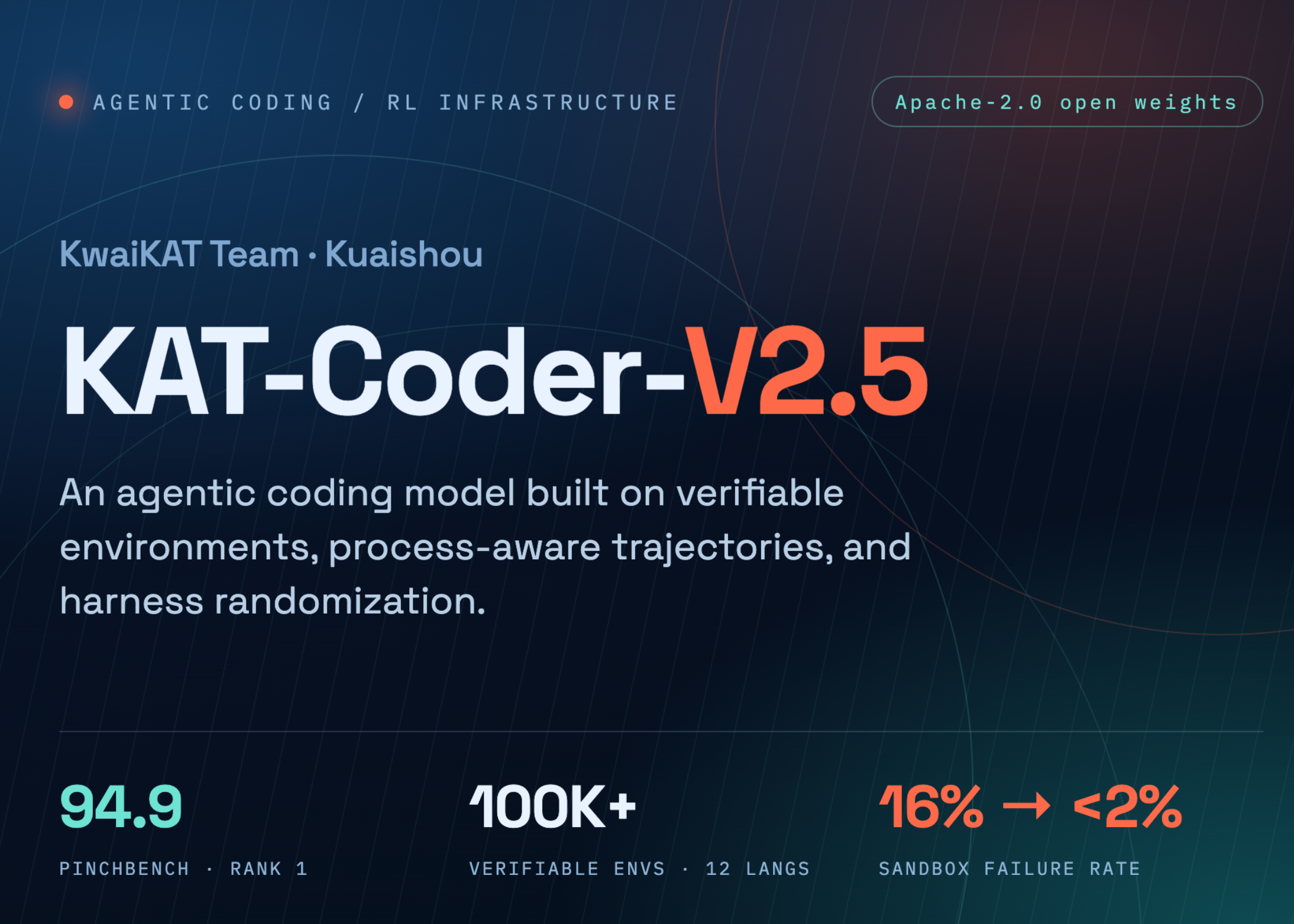
The research team created a tool called “AutoBuilder.” This agent analyzes a repository, writes a configuration script to install dependencies, and runs tests in an isolated sandbox. The acceptance rule is elegantly strict: verification does not simply read exit codes or grep logs. It parses structured test output and only accepts an environment when more than 90% of expected tests pass and outcomes reproduce consistently. By combining base environments with a retrieved library of distilled build recipes, the team lifted the construction success rate from a lowly 16.5% to 57.2%, yielding over 100,000 verifiable environments across 12 languages (Source: MarkTechPost).
The most fascinating lesson from their development process isn’t the fancy MoE architecture—it is the painfully relatable real-world lesson about infrastructure. During training of the previous version, slow “rewards” for the AI were initially blamed on the algorithm. However, an audit revealed that roughly 16% of trajectories failed due to sandbox infrastructure issues rather than the model policy. Boundary misalignments sometimes emptied observations for up to 40 steps, corrupting the feedback loop entirely. Fixing disk usage, environment variables, and API endpoint alignment reduced the sandbox feedback error rate from 16% to under 2% (Source: MarkTechPost). This is a massive real-world lesson for any business owner: AI can’t help you if your underlying setup is broken.
Why This Matters for Malaysian SMEs
Why should you, as an owner managing 20 or 50 staff and focusing squarely on the bottom line, care about a research paper from a foreign big-tech lab? Because this directly addresses the biggest risk you face when trying to automate: a solution that doesn’t fit your specific world.
Most small businesses in Malaysia run a messy but functional patchwork of systems—a little bit of PHP, some Zoho or Odoo, a WooCommerce store, a Shopee listing tool, and a customized accounting software like SQL Account or AutoCount. A generic AI coder outputs “ideal world” code that fails the moment it touches your server. KAT-Coder’s philosophy builds “real world” verification into its very training. The model learns to prioritize fixing the environment rather than just spitting out text that looks correct.
The model’s approach to filtering its training data is particularly useful to understand. The team actively discarded trajectories that “passed” tests through hard-coding or shortcuts. They kept samples that showed strong exploration, localization, and repair behavior, even if they initially failed (Source: MarkTechPost). For an SME, this is the difference between an AI that gives you an answer that looks good, and one that gives you a robust, maintainable solution. An AI that can debug its way through a botched server migration or a weird plugin conflict is infinitely more valuable to a small team than one that just generates text quickly.
Think about your SQL Accounting software. It has its own specific API, its own quirks for handling SST reports, and its own way of naming stock items. A generic AI tool from overseas doesn’t know this. But an AI trained on the concept of adapting to any verifiable environment, using tools like AutoBuilder—that is a shift in capability. It doesn’t just learn code syntax; it learns the act of adapting to your context.
“The KwaiKAT team treats agentic coding as an infrastructure problem, not a model-scale problem.”
— MarkTechPost coverage of KAT-Coder-V2.5 (Source)
The Bigger Picture: Messy Environments Are the Future
This reflects a massive shift in the entire AI industry. The hot new trend isn’t just “bigger models” but “better environments.” The specific academic term here is “verifiable repository environments,” but the business translation is simple: AI is finally learning to deal with your existing mess rather than demanding you adapt to it.
For Malaysian SMEs, this is the key to unlocking serious automation without the constant back-and-forth with freelance developers. The next generation of tools, built on principles from KAT-Coder, will be judged not on the quality of their raw output, but on their ability to successfully run that output in your specific stack. It means you can eventually trust an AI to handle a data migration or a report generator without it breaking everything the moment it touches your actual production database.
The team’s discovery that “boundary misalignments sometimes emptied observations for ~40 steps and corrupting rewards” sounds incredibly technical. In SME terms, this translates to a very human truth: “The AI was failing not because it was stupid, but because the platform it was running on was sending it confusing signals.” This hits home for any Malaysian business owner who has battled a finicky POS system at the retail counter or a slow internet connection break in a shared office building. If the platform is shaky, the smartest tool in the world can’t do its job.
3 Key Principles from KAT-Coder for Your Business Right Now
- Test in the Real World, Not Just a Demo. Look for tools and developers who verify their work in an environment mirroring yours. A passing test on a clean US server is meaningless if the code crashes on your Malaysian shared hosting or mismatched PHP version.
- Fix the Setup First. The research found 16% of coding errors were caused by a broken sandbox, not bad logic. If your server has no free disk space, your plugins are mismatched, or your API keys are expired, no tool—human or AI—will deliver a smooth result.
- Reward the Right Process, Not Just the Pass Rate. The KAT-Coder team actively removed “passing runs” that relied on brittle shortcuts. In your business, an employee or a tool that hacks a solution together without understanding the system is a liability, not an asset.
What This Means for Your Next Automation Project
For the Malaysian business owner reading this, the takeaway is clear. The era of “trust me, it works on my machine” is ending. The release of KAT-Coder-V2.5 signals that the industry is moving toward a standard where verification is non-negotiable.
You should start asking your tech partners harder questions. “Does the automation just generate a script, or does it test it in my specific environment first?” The future belongs to AI that treats your exact setup with the respect it deserves—messy, unique, and full of custom logic specific to the Malaysian market. This is the kind of thinking that actually helps an SME scale operations without needing a full-time dedicated IT department.
At AutoRunBiz, we track these deep infrastructure trends closely because they directly predict what tools will become available to you next quarter. The coding “assistant” is growing up rapidly. It is no longer just a very fast typist. It is becoming a reliable, environment-aware team member who cleans up after itself and checks its own work.
Ready to Streamline Your Operations?
Technology moves fast. Your operations should keep up. AutoRunBiz builds AI systems that run your daily workflows — from WhatsApp order capture to accounting. Book a free 15-min ops audit →