
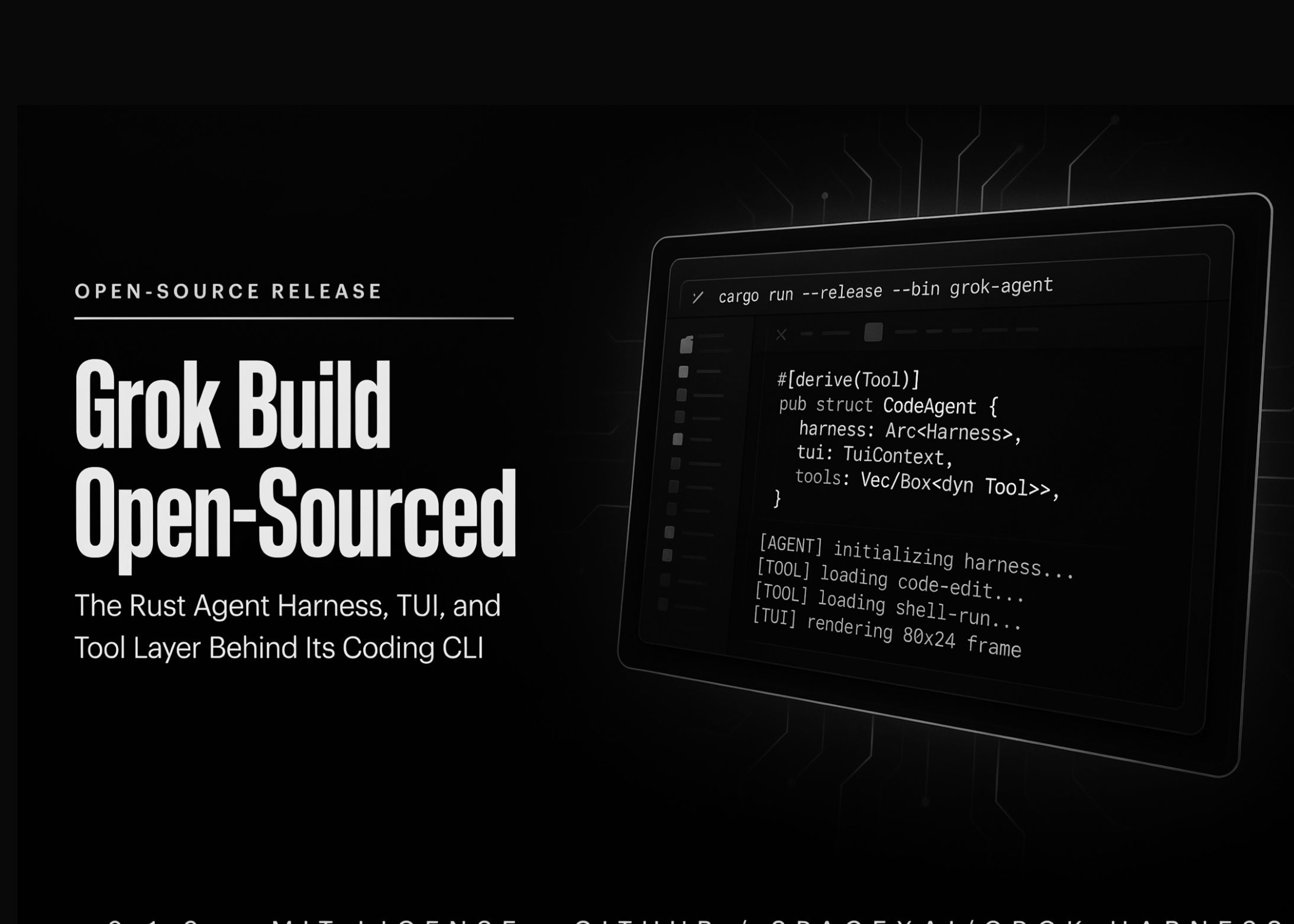
Your Business’s AI Agent Just Got Smarter and Cheaper: What SpaceX’s Open‑Source Move Means for Malaysia
If you run a Malaysian SME, you know the drill: expensive developer hours, rigid software that never quite fits your workflow, and the nagging fear that your data is getting shipped overseas every time you click “AI.” Yesterday, SpaceXAI dropped a bombshell that quietly changes the game — they open-sourced Grok Build, the full Rust‑based agent harness behind their coding CLI. And for Malaysian businesses, the opportunity is bigger than the technical jargon suggests.
TL;DR: SpaceXAI released the entire scaffolding of its AI coding agent under the Apache 2.0 license. You can now compile and run a full‑featured, local‑first AI agent that edits code, executes shell commands, and searches the web — all without sending your sensitive data to a third‑party server. This means Malaysian SMEs can get custom‑tailored AI agents built by local freelancers, keep data inside Malaysia, and avoid vendor lock‑in. No hype, just a practical blueprint that’s already on GitHub.
What Is Grok Build, Really?
Think of Grok Build as the engine behind an AI coding agent. It’s not a model itself; it’s the harness that assembles context, calls a model, parses the reply, and dispatches tool calls. The open-source release covers:
- Agent loop – context assembly, response parsing, tool‑call dispatch
- Tools – read, edit, search, execute shell commands
- Terminal UI – full‑screen, mouse‑interactive interface with inline diff viewer
- Extension system – skills, plugins, hooks, MCP servers, subagents
It launched as an early beta on May 25, 2026, and runs fully local‑first. You configure it with a config.toml file, point it at any model endpoint (from local LLMs to cloud APIs), and it works offline if you’re using local inference.
“The release covers the agent harness, TUI, CLI shell, and developer tooling under the Apache 2.0 license.” – Source Article
Why Open Source Matters for Your Business
Most AI agents you’ve heard of — Claude Code, Codex CLI — are powerful but closed. Once you build workflows around them, you’re tied to that vendor’s model and pricing. For a Malaysian SME, that means:
- Data sovereignty risk: Your customer lists, financial records, or proprietary processes might leave Malaysia every time you invoke the agent.
- Vendor lock‑in: You can’t easily switch models or customise the agent to handle Bahasa Malaysia, Geran documents, or SSM filings.
- Cost: Hiring a full‑time developer to build bespoke tools is expensive (RM 5k–10k/month).
Grok Build flips that. Because it’s Apache 2.0, a local freelancer or dev shop can fork it, add Malaysian‑specific capabilities, and run it on your own server. You keep your data where it belongs, and you’re not locked into any single AI provider.
How It Compares to Alternatives
Here’s a quick look at how Grok Build stacks up against other AI agent frameworks. Data sourced from the official comparison:
| Agent | License | Fork & Modify | Model Choice | External PRs |
|---|---|---|---|---|
Grok Build (xai-org/grok-build) |
Apache 2.0 | Permitted | Any, via config.toml |
Not accepted |
Codex CLI (openai/codex) |
Apache 2.0 | Permitted | OpenAI models only | Open PR queue |
| OpenCode | Apache 2.0 | Permitted | Multiple | Accepted |
Note: Grok Build currently doesn’t accept external PRs, but its open license means you can freely modify your fork.
What This Means for Malaysian SMEs
Let’s get concrete. Here are four ways this release directly benefits a Malaysian business owner:
- Build internal tools faster. Instead of paying a developer weeks to write a script, a freelancer can use Grok Build’s AI agent to generate and test it in hours. The agent edits files, runs shell commands, and searches your codebase — it’s like having a junior dev on demand.
- Keep sensitive data in Malaysia. Run the agent against a local LLM (like Malaysia’s own SEA‑LION) or your own GPU server. Your data never touches a foreign cloud.
- Customise for local workflows. Because you can modify the source, a developer can teach the agent to understand Malaysia‑specific formats: SSM business profiles, LHDN tax forms, or even simple inventory SQL.
- Future‑proof your AI stack. If a better model comes along tomorrow (or pricing changes), just update the
config.toml. You’re not held hostage by any one vendor.
The Bigger Picture
This isn’t just about coding agents. The architectural decisions here — local‑first, modular, open‑source — reflect a broader shift that Malaysian SMEs can ride. Instead of relying on black‑box SaaS platforms that treat your data as a resource, you can now assemble lean, custom AI tools that respect your boundaries. Think of it as the “bawah pokok” approach to AI: simple, practical, and built around what you actually need.
Will your business use Grok Build directly? Probably not. But the dev shop or freelancer you hire can, and that compounds into faster turnaround, lower costs, and better alignment with your operations.
How to Get Started
If you’re a business owner exploring this, here’s a practical path:
- Talk to your developer or IT consultant. Ask them if they’ve seen the Grok Build release. If they haven’t, send them the GitHub repo.
- Identify one manual task that eats up staff time — generating a monthly report, checking inventory, drafting client emails. That’s a perfect candidate for an AI agent prototype.
- Run a small pilot. Get a developer to set up a local Grok Build instance connected to a model (even a cheap cloud API like Groq or Together.ai works). Let the agent automate that one task. Measure time saved.
The best time to explore this was yesterday. The second best time is now — while your competitors are still paying for off‑the‑shelf software that doesn’t quite fit.
Ready to see how this applies to your specific business? Book a free 15‑min call to see how Grok Build can help you automate smarter, cheaper, and locally →