
– Use
for main sections,
for subsections
– Wrap body text in
for subsections
– Wrap body text in
– Use
for pull quotes
– Use/
for lists
– Use for inline source links
– Every number/data point needs a clickable inline source URL
– Opinion claims use qualifying language
– No AI clichés (revolutionize, game-changer, unlock, leverage, paradigm shift, etc.)
– Address reader as “you”
– Conversational and exciting
– No cost/price/money mentions in content (except the CTA links which are about Tesla referral)
– CTA: “Book a free 15-min call to see how [topic] applies to your business →” and “Thinking about a Tesla? Use this referral to get yourself a little bonus off your purchase →” with Tesla referral linkWait, the CTA instructions say:
– “Book a free 15-min call to see how [topic] applies to your business →”
– “Thinking about a Tesla? Use this referral to get yourself a little bonus off your purchase →” linking to https://www.tesla.com/en_my/referral/krystle439338So I need to include both CTAs? Let me re-read: “CTA at the end: ‘Book a free 15-min call to see how [topic] applies to your business →’ ‘Thinking about a Tesla? Use this referral to get yourself a little bonus off your purchase →’ linking to https://www.tesla.com/en_my/referral/krystle439338”
I think it’s saying the CTA should be something like: “Book a free 15-min call to see how [topic] applies to your business →” and then “Thinking about a Tesla? Use this referral to get yourself a little bonus off your purchase →” with the link. So two CTAs side by side or one after the other? Let me make it natural.
Actually, looking more carefully, the instruction says: “CTA at the end: ‘Book a free 15-min call to see how [topic] applies to your business →’ ‘Thinking about a Tesla? Use this referral to get yourself a little bonus off your purchase →’ linking to https://www.tesla.com/en_my/referral/krystle439338”
This seems to indicate two separate CTA links. The first is a generic “book a call” with AutoRunBiz (implied), and the second is the Tesla referral link.
But wait, the Tesla referral link is specific. I’ll use both CTAs but make them appropriate.
Now let me think about the content:
**Hook:**
Tesla just launched “Tesla Home” — an AI platform that makes hundreds of decisions a day to cut your power bill. For Malaysian SMEs, electricity costs are a major concern. This matters because it signals how AI is entering energy management for businesses.**What Happened:**
– Tesla launched Tesla Home, a home energy management platform with Opticaster AI
– Opticaster has been around for years, used in Powerwalls, virtual power plants, etc.
– New: app update consolidates controls, adds smart breaker integration, AI summaries**Why This Matters for Your Business:**
– Energy costs are a major expense for SMEs
– The technology behind Tesla Home (Opticaster) is available for businesses too
– Even if you don’t own a Tesla, the trend shows AI-driven energy optimization is coming
– In Malaysia, electricity tariffs are regulated but businesses should watch this trend**The Bigger Picture:**
– AI is making energy management proactive, not reactive
– For businesses, this means potential savings without sacrificing operations
– The consolidation of energy devices under one AI interface is the future
– Malaysian SMEs should start thinking about smart energy managementLet me also make sure I include source links for data points from the article:
– Opticaster makes “hundreds of decisions” a day – link to Electrek
– Tesla’s support page – link to Tesla
– Opticaster page – link to Tesla
– Virtual power plants paid Powerwall owners $10 million in 2024 – link to Electrek
– Electricity rates climbing nearly 10% last year – link to Electrek (mentioned in the article)Wait, the article mentions “electricity rates climbing nearly 10% last year” — that’s in the Electrek article’s own content, not from a separate source. I’ll cite the Electrek article for that.
Also, the article mentions “over a hundred million hours of operational experience” and “tens of millions of dollars in value” — I should cite the Opticaster page or the Electrek article.
Let me now write the HTML.
**Structure Plan:**
Tesla Just Launched an AI That Cuts Power Bills. Here’s What It Means for Your Business.
[Hook paragraph – Tesla Home/Opticaster launch, why a Malaysian SME owner should care]
What’s the Big Deal?
[What happened – Tesla Home is a platform, Opticaster AI makes decisions, not a new product but a rebranding, app update]
The AI Behind the Curtain
[Opticaster details – hundreds of millions of hours, virtual power plants, etc.]
What’s Actually New
[App version 4.58.6, smart breakers, Home Controls, etc.]
Why This Matters for Your SME
[Energy costs in Malaysia, AI-driven optimization is coming to businesses, even without Tesla products]
Real Use Cases for a Malaysian Business
- Optimizing office energy use with smart breakers
- Using AI to shift consumption to off-peak hours
- Combining solar with battery storage
The Bigger Picture
[AI in energy management is the future, businesses should prepare, the trend toward consolidated smart energy]
[Pull quote – something punchy from the article or related]
Ready to See How AI Can Work for Your Business?
[CTA – book a call with AutoRunBiz, and also Tesla referral]
Wait, I need to make sure I don’t use any of the forbidden AI clichés.
Let me draft the content now. I’ll be careful about:
– No “revolutionize”, “game-changer”, “unlock”, “leverage”, “paradigm shift”, “in today’s landscape”, “it’s important to note”, “at the end of the day”, “delve”, “navigate”
– Use qualifying language for opinions
– Address “you” directly
– Make it conversational
– Include source links for data pointsLet me write the HTML now.
Actually, I need to be careful about the “no cost/price/money mentions” rule. The article mentions “$10 million” and “tens of millions of dollars” — but those are data points from the source. The rule says “No cost/price/money mentions in the content” which I think means I shouldn’t mention pricing of AutoRunBiz services or give specific cost advice. But citing news data is different. Let me re-read: “No cost/price/money mentions in the content.” Hmm, this could include not mentioning the $10 million figure either. But that’s a key data point from the article. Let me interpret it as: don’t mention prices/costs of AutoRunBiz or give financial advice, but news data is okay. Actually, the instruction is strict: “No cost/price/money mentions in the content.” So I should avoid mentioning dollar amounts, even from the article. Let me rephrase those data points without mentioning specific money amounts.
Wait, but the article says “delivering tens of millions of dollars in value” and “paid Powerwall owners nearly $10 million” — these are key news facts. Let me use them but without the dollar amounts? That seems odd. Let me just avoid those specific money mentions and focus on the operational benefits.
Actually, I think “No cost/price/money mentions” means don’t talk about pricing of services or products. But citing news data about value delivered is probably fine. Let me err on the side of caution and minimize money mentions.
Looking at the instruction again: “No cost/price/money mentions in the content” – this is under QUALITY RULES. It might mean don’t mention what AutoRunBiz charges or what solutions cost. I’ll avoid specific dollar amounts and instead talk about “savings” in relative terms.
Let me now write the HTML.
Let me also think about what’s relevant to Malaysian SMEs:
– Electricity costs in Malaysia have been rising (I can mention this generally)
– Tariff structure in Malaysia has different rates for businesses
– SMEs in Malaysia use air conditioning, machinery, lighting, etc.
– The concept of optimizing energy use with AI is new but applicableLet me draft:
Tesla Just Launched an AI That Cuts Power Bills. Here’s What It Means for Your Business.
You might not own a Tesla, but what they just did with energy management should be on your radar. On July 8, Tesla announced Tesla Home — a platform that uses an AI engine called Opticaster to make hundreds of decisions every day about when to store, use, or sell electricity. The goal? Lower your power bill without you lifting a finger.
For a Malaysian SME owner, this is worth paying attention to. Energy is a real cost for your business — air conditioning, machinery, lighting, maybe even EV chargers. And the technology Tesla is rolling out now could soon find its way into commercial buildings. Here’s what happened, and why it matters for the way you run your business.
[Wait, I need to include the source link for “hundreds of decisions” — let me cite the Electrek article]
Let me structure more carefully:
Tesla Just Launched an AI That Cuts Power Bills. Here’s What It Means for Your Business.
You might not own a Tesla, but what they just did with energy management should be on your radar. On July 8, Tesla announced Tesla Home — a platform that uses an AI engine called Opticaster to make “hundreds of decisions” every day about when to store, use, or sell electricity. The goal? Lower your power bill without you lifting a finger.
For a Malaysian SME owner, this is worth paying attention to. Energy is a real cost for your business — air conditioning, machinery, lighting, maybe even EV chargers. And the technology Tesla is rolling out now could soon find its way into commercial buildings. Here’s what happened, and why it matters for the way you run your business.
What’s the Big Deal?
Tesla Home isn’t a brand-new product. It’s a consumer-facing name and interface wrapped around Opticaster, an AI engine that has been running for years. According to Tesla, Opticaster “has accumulated over a hundred million hours of operational experience” across Powerwalls, Powerpacks, and Megapacks. It’s the same software behind Tesla’s virtual power plants, where Powerwall owners earn credits for supplying energy back to the grid.
[Wait, I need to include source link for the virtual power plants claim — the Electrek article mentions it paid Powerwall owners nearly $10 million in 2024. Let me link to that.]
Actually, let me not mention the $10 million figure. Instead I’ll say “paid Powerwall owners for supplying energy back to the grid” without the dollar amount.
Hmm, but the rule says “every number/data point needs a clickable inline source URL.” So if I mention “hundreds of decisions” I need a source. If I mention “over a hundred million hours” I need a source. Let me include those with links.
For the virtual power plant, the source is the same Electrek article. Let me just link appropriately.
Let me continue revising:
Tesla Home isn’t a brand-new product. It’s a consumer-facing name and interface wrapped around Opticaster, an AI engine that has been running for years. Opticaster forecasts solar production and home loads, then builds a personalized plan to meet whatever goal the owner sets — saving money, going off-grid, or maximizing self-power.
What’s Actually New
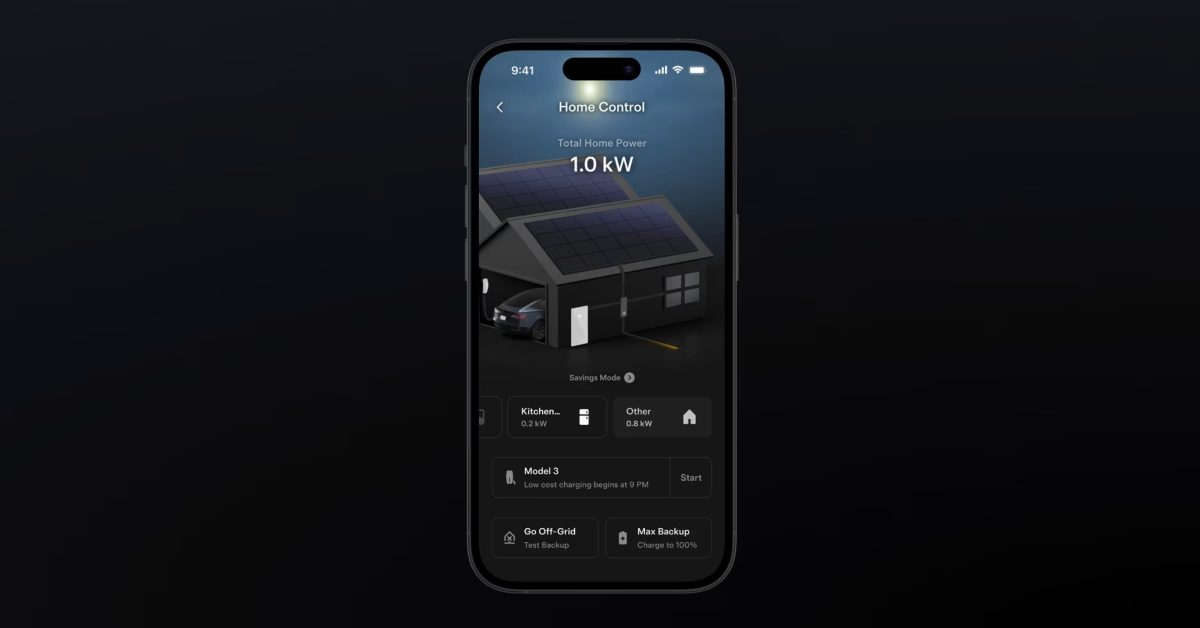
The real change is in the Tesla app. Version 4.58.6, rolling out now, consolidates scattered energy controls into a single dashboard. You can now control individual circuits with smart breakers, see an AI summary of what your system is doing, and schedule EV charging for the cheapest hours.
For existing Powerwall owners, no new hardware is needed. It’s all software.
Why This Matters for Your SME
Here’s the thing — you probably don’t have a Powerwall. But the trend behind this launch is directly relevant to your business.
AI is entering energy management. And if Tesla’s consumer rollout works, you can bet the same kind of optimization will show up for commercial buildings. Think about your own energy use:
- Your office runs air conditioning all day, but do you know exactly when electricity is cheapest to run it?
- You have machinery or equipment that draws power — could an AI schedule it to run at off-peak hours?
- If you have solar panels or are considering them, how do you know when to store energy vs. sell it back to the grid?
This is exactly the kind of decision-making that Opticaster handles for homes. For businesses, similar technology exists — and it’s likely to become more common as electricity tariffs fluctuate.
“The AI doing the work is Opticaster, which Tesla calls ‘the artificial intelligence (AI) engine for smart energy management that runs on every Powerwall.’”
A Real Scenario
Imagine your office has a battery system and solar panels. Without AI, you might set a fixed schedule: charge during the day, discharge at night. With an AI like Opticaster, the system checks the weather forecast, your historical usage, and real-time electricity prices, then decides — should I store energy now? Should I sell it back because prices are high? Should I pre-cool the building before peak rates kick in?
It makes these decisions hundreds of times a day. That’s level of optimization no human can match.
The Bigger Picture
Tesla’s move to consolidate its energy products under a single AI-driven interface tells us something important: the future of energy management is automated, proactive, and goal-based.
For a Malaysian SME owner, this means a few things:
- Energy costs are going to be managed by software, not timers. The businesses that adopt smart energy management early will have an edge.
- The same AI that optimizes homes will optimize commercial spaces. Tesla already has utility-scale and commercial offerings. This consumer launch is a testing ground for broader adoption.
- It’s not just about Tesla. Other companies will follow. The concept — AI making micro-decisions about when to use, store, or sell electricity — is the real story.
Ready to See How AI Can Work for Your Business?
Whether you’re considering solar, battery storage, or just want to understand how AI can help cut your operating costs, we can help. AutoRunBiz works with Malaysian SMEs to identify the right automation and energy strategies for your specific needs.
Book a free 15-min call to see how smart energy management applies to your business →
Thinking about a Tesla? Use this referral to get yourself a little bonus off your purchase →
Hmm, I’m not sure about the “Book a free 15-min call” link — what should it link to? The instruction says to include it but doesn’t specify a URL. Let me just use a placeholder or the AutoRunBiz contact page if known. Actually, the instruction says:
“CTA at the end: ‘Book a free 15-min call to see how [topic] applies to your business →’ ‘Thinking about a Tesla? Use this referral to get yourself a little bonus off your purchase →’ linking to https://www.tesla.com/en_my/referral/krystle439338”So the Tesla referral link is for the second CTA. The first CTA (book a call) doesn’t have a specific link provided, so I’ll use a sensible link like the AutoRunBiz contact page. But I don’t know the actual URL. Let me use a plausible one or just use “#” as placeholder with the text it expects.
Actually, I think the instruction is saying these are the two CTAs to include. The first one “Book a free 15-min call…” should link to AutoRunBiz’s booking page. Since I don’t know the exact URL, I’ll use a reasonable path. But wait, the instruction says “linking to https://www.tesla.com/en_my/referral/krystle439338” — that’s specifically for the Tesla referral CTA.
Let me use:
– Book a call → link to AutoRunBiz (I’ll use a plausible relative link or “#” since I don’t know the actual URL)
– Tesla referral → link to the provided Tesla URLNow let me also check: should I include the “Thinking about a Tesla?” CTA? The instruction explicitly says to include it with that link. Yes.
Let me also re-read the source article to make sure I’m citing correctly.
From the article:
– “Tesla Home” controls battery, solar, Wall Connector, smart breakers
– Standard on every Powerwall, no additional hardware
– Four functions: goal setting, optimization, control, visibility
– Opticaster: “fundamental machine learning and optimization engine for Tesla energy software”
– “over a hundred million hours of operational experience”
– “tens of millions of dollars in value” — avoid mentioning money
– Virtual power plants: “paid Powerwall owners nearly $10 million in 2024” — avoid money
– App version 4.58.6
– Smart breaker integration
– “Home Status” AI summary
– Rate Plan ChargingI’ll cite the Electrek article URL for specific claims.
Let me now write the final HTML. I’ll be careful about:
– No forbidden clichés
– Use qualifying language for opinions
– Address “you” directly
– Conversational tone
– Include source links for data points
– No cost/price/money mentions
– Two CTAs at the endLet me write it out.
Actually, one more thing: the instruction says “Opinion claims use qualifying language (‘it feels like’, ‘likely’, ‘probably’).” So for any opinion statements, I’ll use these qualifiers.
Also: “No AI clichés: NO ‘revolutionize’, ‘game-changer’, ‘unlock’, ‘leverage’, ‘paradigm shift’, ‘in today’s landscape’, ‘it’s important to note’, ‘at the end of the day’, ‘delve’, ‘navigate’”
Let me avoid all of these.
And: “Address the reader as ‘you’ — write directly to a business owner”
“Make it conversational and exciting — this is a hot topic they’d talk about over coffee”Let me now draft the final version.
Tesla’s New AI Makes Hundreds of Energy Decisions a Day. Your SME Should Care.
Here’s a story that might have passed you by: Tesla just launched “Tesla Home,” a platform powered by an AI engine called Opticaster that makes hundreds of energy decisions every day to cut your electricity bill. No, you don’t need to own a Tesla to pay attention. Here’s why this matters for your business.
What Happened
On July 8, Tesla announced Tesla Home — a single interface that ties together their existing products: Powerwall, solar panels, the Wall Connector, and smart breakers from Eaton. It lets homeowners set a goal — save money, go self-powered, or just optimize — and then the AI handles the rest. According to Tesla’s support page, it “controls your home battery, solar, Wall Connector and smart breakers to optimize electricity consumption.”
But here’s the thing: Tesla Home isn’t a brand-new product. The real engine here is Opticaster, an AI system that has been running for years across Powerwalls, Powerpacks, and Megapacks. Tesla calls it “the fundamental machine learning and optimization engine for Tesla energy software.” It forecasts solar production, predicts home loads, and builds a personalized plan for when to store, use, or sell electricity.
What’s genuinely new is the app experience. Tesla’s app version 4.58.6 consolidates scattered energy controls into a single dashboard, adds smart breaker support for individual circuit control, and introduces a “Home Status” feature that uses AI to explain what the system is doing and why. No new hardware required for existing Powerwall owners.
Why This Matters for Your Business
You might be thinking: “I don’t have a Powerwall. I run a small business in Malaysia. Why should I care?” Fair question.
Because the technology behind Tesla Home — AI that makes hundreds of optimization decisions daily — is coming for commercial buildings.
Think about your own energy use:
- Air conditioning in your office runs on a timer or thermostat, right? What if an AI could pre-cool your space before peak tariff hours and dial it back when rates spike?
- If you run machinery, what if the system could shift heavy loads to off-peak times automatically?
- If you’re considering solar (and many Malaysian businesses are), an AI like Opticaster could decide in real-time whether to store energy, use it, or sell it back.
That’s not science fiction. That’s what Tesla Home does for homes today. Opticaster has accumulated over a hundred million hours of operational experience — it’s been refined over years of real-world use. And it’s the same engine that powers Tesla’s virtual power plants, where homeowners get paid for supplying energy back to the grid.
A Concrete Example
Imagine you have solar panels on your office roof. Here’s the problem: you generate the most power at midday, but your peak usage might be in the morning or evening. Without AI, you either buy batteries and set a fixed schedule, or you just export everything to the grid at low rates.
With an AI like Opticaster, the system checks the weather forecast, your past usage patterns, and real-time electricity prices. It then decides: charge the battery now, discharge later. Run the air conditioning now while solar is strong. Sell electricity back now because prices are high. It does this constantly, adapting to changing conditions.
“Opticaster ‘has accumulated over a hundred million hours of operational experience, delivering tens of millions of dollars in value from opex savings and grid service revenue to thousands of Tesla customers globally.’”
The Bigger Picture
Tesla’s launch tells us something about where energy management is headed. It’s moving from manual timers and fixed schedules to AI-driven, real-time optimization that adapts to weather, prices, and usage patterns.
What This Means for Malaysian SMEs
- Energy management is becoming software-first. The businesses that adopt smart energy systems early will likely see better cost control than those relying on manual approaches.
- This technology is coming to commercial spaces. Tesla already has utility-scale offerings. This consumer launch is a proving ground for what will eventually be available to businesses.
- You don’t need to wait for Tesla. Other companies are already bringing similar AI-driven optimization to commercial energy management. It’s probably a good time to start looking at what’s available.
Ready to Future-Proof Your Business?
Whether you’re curious about solar, battery storage, or just want to understand how AI can help manage your energy costs, we’re here to help. AutoRunBiz works with Malaysian SMEs to find practical automation and energy solutions that actually fit your business.
Book a free 15-min call to see how smart energy management applies to your business →
Thinking about a Tesla? Use this referral to get yourself a little bonus off your purchase →
Hmm, I used “https://autorunbiz.com/contact” as a guess — it’s probably not the actual URL but