
Why Your Business Needs to Know About GPT‑Live
Imagine a customer calls your shop with a question about your services. The current voice systems often force them to say “Hello” then wait for a beep, speak in fragmented sentences, or get interrupted by awkward silences. Worse, when a deeper question comes up (like “Can your team handle a last‑minute bulk order?”), the voice model either stumbles or sends the call to a clunky menu tree. That frustration is just one pain point that OpenAI’s new GPT‑Live model family aims to solve.
TL;DR
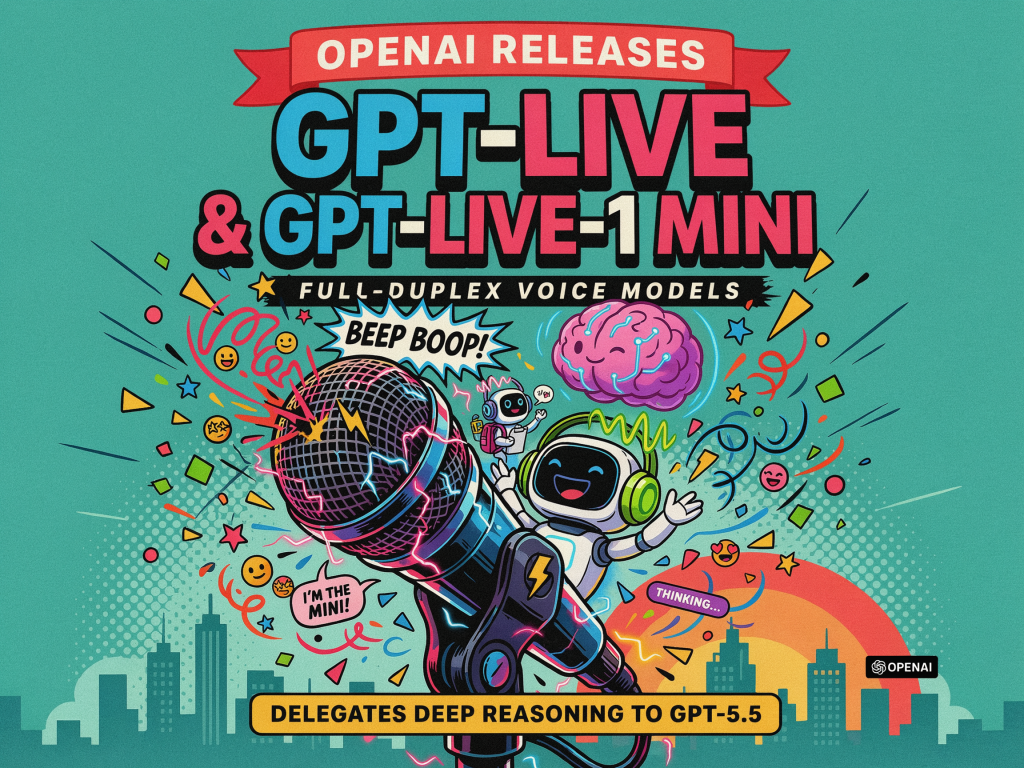
GPT‑Live is a full‑duplex voice model that listens and speaks at the same time, just like a human conversation. It hands off complex reasoning to GPT‑5.5 in the background while keeping the chat flowing naturally. In early tests, users strongly preferred it over the previous Advanced Voice Mode. The model is rolling out to ChatGPT users today, and an API is planned soon.
How Full‑Duplex Voice Changes the Conversation
Current voice AI systems fall into two camps. The older “cascaded” systems chain three separate models (speech‑to‑text → language model → text‑to‑speech) per turn. That slaps a delay between every sentence and loses nuance in translation. The newer “turn‑based” models (like ChatGPT Advanced Voice Mode) process audio inside one model, but they still rely on detecting silence to know when you’re done speaking. A short pause or background noise often triggers an interruption or a long, awkward gap.
GPT‑Live uses a full‑duplex architecture: it processes your speech while generating its own output at the same time. It can make decisions many times per second – to listen, speak, interject with “mhmm,” pause, or hand off a task to a more powerful model. This creates a natural back‑and‑forth that feels much closer to a real conversation.
“Full‑duplex means the model can listen and speak at the same time. During a conversation, it can add short cues like ‘mhmm’ or ‘yeah.’” – OpenAI
The Two Architectural Leaps Behind GPT‑Live
1. Continuous Interaction
The model can handle speech input and output simultaneously. Instead of waiting for a silence gap, it decides in real time whether to keep listening, produce a response, or interrupt with a clarification. This eliminates the robotic “your turn, my turn” rhythm and makes the whole interaction feel faster and more human.
2. Delegation for Deeper Work
When a request needs web search, step‑by‑step reasoning, or complex calculations, GPT‑Live passes the task to a frontier model – at launch, that’s GPT‑5.5. While GPT‑5.5 works in the background, GPT‑Live continues the conversation normally. The result pops back in when it’s ready, without you having to wait or repeat yourself.
GPT‑Live vs. Previous Voice Systems: A Side‑by‑Side Look
To see why full‑duplex matters, here’s how the three architectures compare:
| Dimension | Cascaded (original ChatGPT Voice) | Turn‑based (Advanced Voice Mode) | Full‑duplex (GPT‑Live) |
|---|---|---|---|
| Pipeline | STT → LLM → TTS, three models | Single model handling audio | Single model, continuous processing |
| Turn handling | Discrete turns | Discrete turns, silence‑based | Continuous, decisions many times/sec |
| Listen while speaking | No | No | Yes |
| Backchannels (“mhmm”) | No | No | Yes |
| Latency feel | Slow, stilted, long pauses | Faster, smoother, still rigid | Fast, natural, expressive |
| Interrupt handling | Not supported | Can misfire on pauses/noise | Can pause, interrupt, resume |
| Deeper work | In‑line LLM | In‑line model | Delegates to GPT‑5.5 in background |
In human preference tests with matched five‑to‑ten‑minute conversations, both GPT‑Live‑1 and GPT‑Live‑1 mini were strongly preferred over Advanced Voice Mode across measures of turn‑taking, interruptions, flow, and overall naturalness.
Practical Use Cases for Malaysian SMEs
You can test GPT‑Live today within ChatGPT on your phone. For business owners, it opens up several realistic scenarios:
- Hands‑free help: While on a site visit or in the stockroom, ask for cooking steps (if you run a café), product specifications, or directions without touching a screen.
- Live translation: Full‑duplex timing can translate speech during a conversation – useful if you deal with suppliers or customers who speak different languages.
- Research on the go: Ask a complex question about market trends or your industry during your commute; GPT‑5.5 searches the web in the background, and GPT‑Live keeps talking to you while you wait.
- Customer support workflows: The model can handle multi‑step telecom‑style tasks (check order status, update address, escalate) with a natural voice interface that doesn’t interrupt or misunderstand silences.
- Language practice: If your team wants to improve English or Mandarin for client calls, GPT‑Live can hold back‑and‑forth chats with gentle corrections – no more awkward “repeat after me” drills.
The Bigger Picture: Voice AI as a Layer, Not the Brain
One of the most interesting decisions in GPT‑Live is the separation of the voice interaction layer from the underlying reasoning engine. Instead of trying to make one model do everything, OpenAI decoupled “natural conversation” from “deep thinking.” This means the voice model can be lightweight and responsive, while the heavy lifting (web search, math, logic) is handled by a dedicated model behind the scenes.
For an SME, that design is a reminder: you don’t need a massive all‑in‑one system to get good voice AI. The interface can be simple and fast, as long as it knows how to pass the hard questions to a back‑end service. That architecture is already common in good customer‑service software, and it’s likely to become the standard for voice assistants in the near future.
The API isn’t available yet, but once it is, you could plug this full‑duplex voice layer into your own business apps – imagine a service that talks naturally with your customers while automatically checking inventory, scheduling appointments, or running a credit check in the background.
Ready to explore how natural‑voice interactions could streamline your customer support or internal operations?
Book a free 15‑min call to see how [full‑duplex voice AI] applies to your business → https://autorunbiz.com